


Today’s Dietitian
Vol. 28 No. 4 P. 38
Take this course and earn 2 CEUs on our Continuing Education Learning Library
The 2025–2030 Dietary Guidelines for Americans (DGA) were released on January 7, 2026, and made big waves in and beyond the nutrition world. A new graphic, an increase in protein recommendations, and the endorsement of foods rich in saturated fat are only some of the changes to the most updated version of the DGA, along with a decrease in length of the final document.
The purpose of the DGA is not to provide clinical guidance, individual meal plans, or personal recommendations but instead to function as population-level guidance. They also help inform nutrition policy and programming, specifically federally funded programs such as SNAP, school foodservice, and child care and elder care nutrition programs.
A Brief History of the DGA
Understanding the evolution of the DGA helps contextualize the recommendations in the current edition. The first federal nutrition guidance was published in 1977 as both the Dietary Goals for the United States and the McGovern Report.1 Issued by the Senate Select Committee on Nutrition and Human Needs, which was chaired by Senator George McGovern of South Dakota, its purpose was to provide “prudent dietary recommendations based on scientific knowledge.”1 In 1979, it was replaced by Healthy People: The Surgeon General’s Report on Health Promotion and Disease Prevention, a 179-page report aiming “to enhance both individual and national perspectives on prevention of ill health and premature death through identification of priorities and specification of measurable goals.”2
The first official edition of the DGA, Nutrition and Your Health: Dietary Guidelines for Americans, was published in 1980. It emphasized limiting sodium, sugar, saturated fat, and cholesterol, maintaining an “ideal weight,” and moderating alcohol consumption.3 Between 1983 and 1985, the original Dietary Guidelines Advisory Committee (DGAC) reviewed the science and public feedback, yielding a second edition and updated graphic.4
The 1990 DGA was the second report to add scientific justification to the guidelines, referencing the 1988 Surgeon General’s Report on Nutrition and Health, the 1989 Recommended Dietary Allowances, and Diet and Health: Implications for Reducing Chronic Disease Risk.5 In 1995, the fourth edition introduced an Olympic rings-style graphic and legally required updates every five years under the National Nutrition Monitoring and Related Research Act of 1990. This edition emphasized food as a tool for social connection and enjoyment, not solely for nutrition, and introduced the original Food Guide Pyramid, with dietitians contributing to the committee.6,7
In 2000, the DGA theme shifted to “aim for fitness, build a healthy base, and choose sensibly for good health,” accompanied by colorful charts and visuals.8 The 2005 edition positioned the DGA as “a primary source of dietary health information for policymakers, nutrition educators, and health providers,” including an executive summary, key recommendations, and guidance on meeting intake goals through Dietary Reference Intakes. Food patterns like the DASH diet, BMI charts, and child growth charts were also included.9
The 2010 DGA focused on nutrition education and policy, introducing the concept of the food environment as a contributor to health. Appendices included USDA food patterns at varying calorie levels, vegan adaptations, and a glossary of terms. MyPlate was introduced in 2011 as a practical teaching tool for professionals and the public.
The 2015–2020 edition highlighted chronic disease prevention and medical cost implications while acknowledging food as a reflection of culture and tradition, emphasizing balanced meals and snacks rather than individual nutrients.10 The 2020–2025 DGA, themed “Make Every Bite Count,” provided expanded guidance across the lifespan, emphasizing dietary patterns, intake trends, and population-specific considerations. It was a comprehensive, data-rich resource with tables, charts, and definitions to support both public and professional audiences.11
The most recent 2025–2030 edition has been described by the government as “the most significant reset of federal nutrition policy in our nation’s history,” with a clear, simple message: eat real food.12 The new, updated website includes links to the government’s press conference, The Scientific Foundation Appendices, The Scientific Foundation for the Dietary Guidelines for Americans, The Daily Serving Guide, and an AI tool for answering nutrition-related questions.
How the DGA Are Developed and Updated
Committee Structure and Process
The DGA are released every five years. Between updates, a Scientific Advisory Committee—selected by the US Department of Health and Human Services (HHS) and the USDA and informed by public nominations—reviews current evidence. The committee is designed to include a diverse group of experts across disciplines; dietitians have been amongst its members in the past.13 For two years, the committee evaluates scientific research and incorporates public and stakeholder input. This process results in a comprehensive scientific report that serves as the foundation for the DGA. Federal agencies translate this report into public-facing guidance. Evidence is reviewed using three primary methods (data analysis, systematic reviews, and food pattern modeling), which are all intended to reduce bias.13
Changes to the 2025–2030 Process
The 2025–2030 DGA followed a revised process, with the current administration calling for a new committee structure to “establish a rigorous scientific foundation for the Dietary Guidelines for Americans.”14 A central critique of prior guidelines was their use of a health equity lens, defined as ensuring equitable access to nutrition information and resources needed to support healthy dietary patterns and reduce disparities across diverse communities.15 This approach recognizes that social, economic, cultural, and environmental factors influence both food access and health outcomes.
Additional detail is provided in Part B, Chapter 2: Health Equity and Nutrition of the 2025 DGAC Scientific Report.15 The committee, formed in 2022, submitted its final report to HHS and USDA in December 2024 after holding seven meetings and multiple public comment periods, all of which are publicly available.16
The 2025–2030 edition of the DGA is described as being based upon nutrition science that informs the prevention and reversal of chronic disease and support of optimal health.14 Their experts were chosen “through a federal contracting process based on demonstrated expertise.”14 Notably there were no dietitians included in this panel. Protocols were created before the review by a methodology expert and the reviewers evaluated the literature.14 The final version does not reflect several of the scientific recommendations from the advisory committee, including those developed through a health equity lens, which was viewed as a methodological deficiency.16,17 The new committee concluded that “science should inform policy—not be constrained by it” and that concerns surrounding food access should be secondary to the establishment of “clear, unbiased scientific guidance on the optimal diet for Americans” without “ideological bias, institutional conflict, or predetermined conclusions.”14
Industry Ties and Public Trust
One area of public critique related to the smaller, newly appointed committee was the presence of multiple industry ties amongst some members. These included connections to the beef and dairy industries, which critics suggest may have influenced elements of the DGA, including the updated graphic and saturated fat recommendations.14 Upon release, potential conflicts of interest were disclosed online, including compensation, research funding, patents, book royalties, and advisory roles. Even when publicly disclosed, these relationships may reduce confidence in the recommendations, contribute to skepticism about potential bias, and affect implementation, particularly in communities with lower trust in federal nutrition guidance. It is important to note that industry ties have been present across both past and current advisory committees.
Comparing the 2020–2025 DGA With the 2025–2030 DGA
The first difference between the DGAs is the length. The 2020–2025 DGA was 149 pages, while the new DGA is noticeably shorter at only nine pages. Many of the tables, appendices, and charts explaining the differences between different types of foods, nutrients, and products have been removed.
At a glance, the most consistent themes between the two are the following:
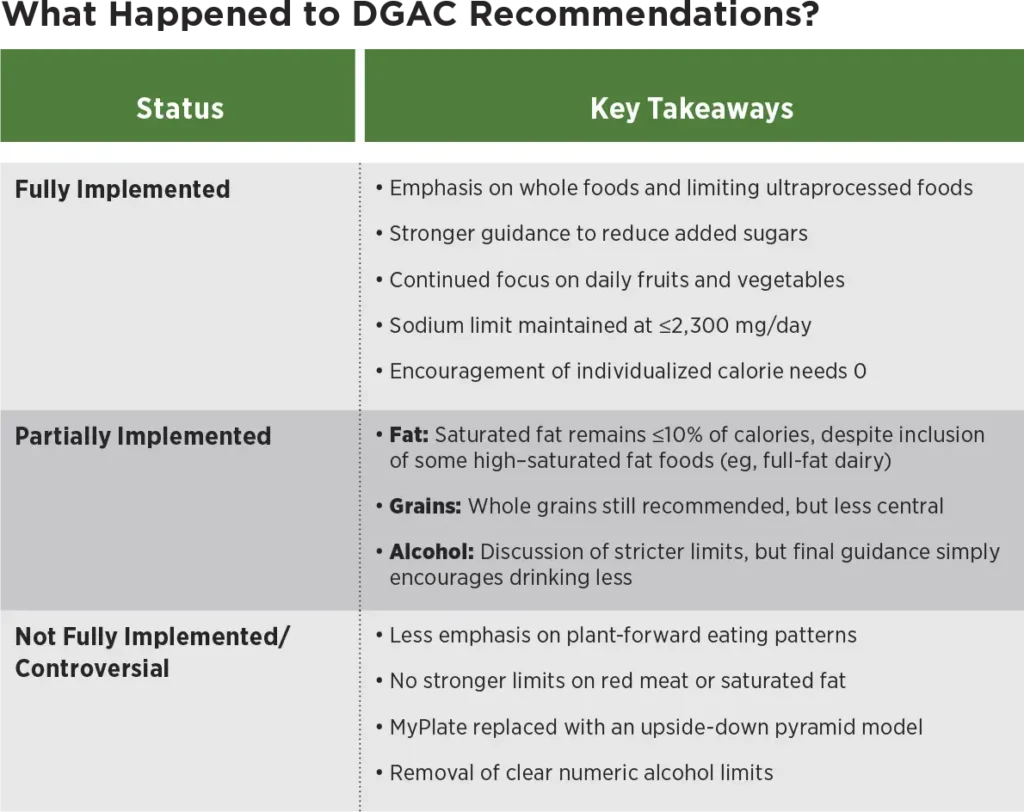
- choosing whole foods when possible and limiting processed foods;
- prioritizing variety in the diet; and
- limiting or eliminating food additives, artificial flavors, and ultraprocessed foods (UPFs).
Building on these themes, the most notable updates in this edition reflect a shift in both messaging and priorities. Below is a summary of the five main areas of focus:
1. “Real Food” Lens
- New guidelines emphasize whole or minimally processed foods
- UPFs and refined carbohydrates are discouraged
2. Higher Protein Intake
- Protein intake recommendation increased from 0.8 g/kg to 1.2–1.6 g/kg/day
- Greater emphasis on animal protein sources
3. Added Sugar Guidance Tightened
Previous: ≤10% of daily calories
New: ≤10 g added sugar per meal
4. Full-Fat Dairy Encouraged
- Shift from low-fat or fat-free dairy to encouraging full-fat dairy options
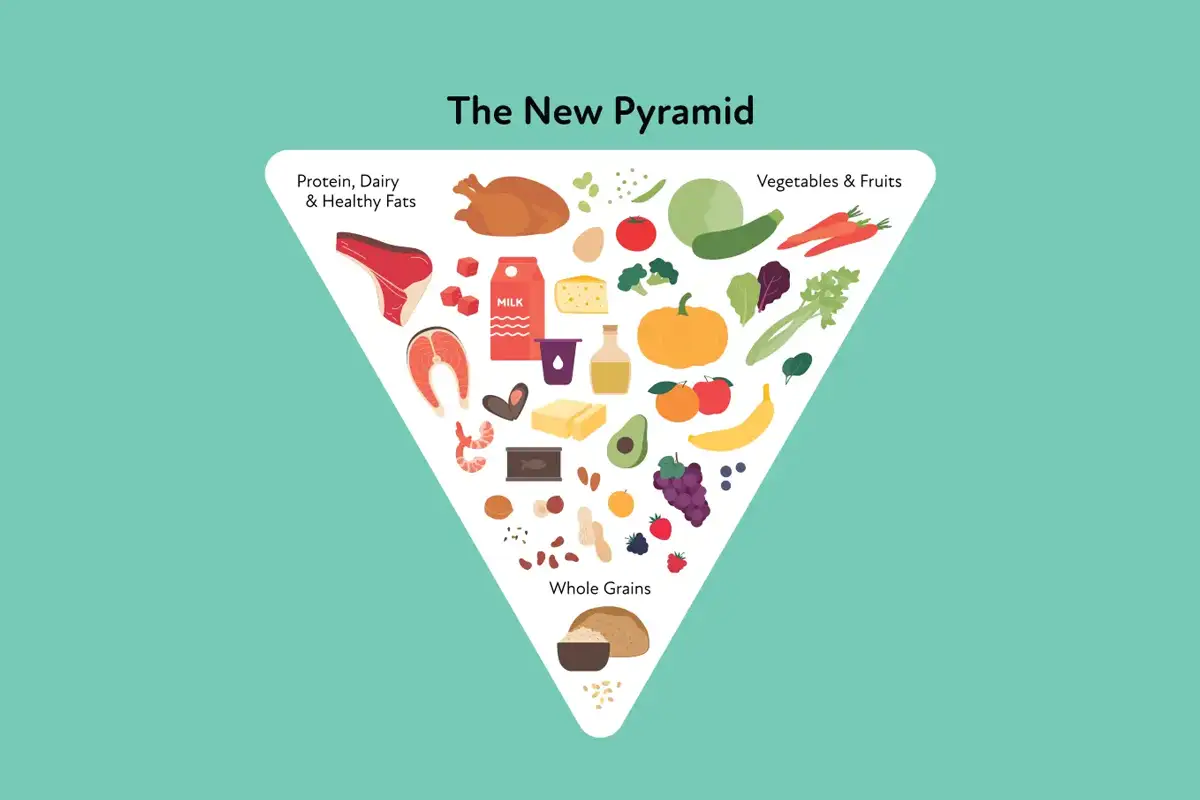
5. New Food Pyramid
- Replaces MyPlate
- Emphasizes animal protein, full-fat dairy, healthy fats, fruits, and vegetables, with smaller grain focus
Key Revisions and Omissions
In addition to new recommendations, several previously included components were removed or revised, with notable gaps in guidance for both clinicians and the general public.
Revised Food Guide Pyramid
The visual of the upside-down pyramid is a big departure from MyPlate, the widely recognized graphic that was previously used by community health educators and clinicians. This is important not only because of its use as a teaching tool but also because it is what most Americans associate with the DGA.18
Eating Patterns, Personalization, and Cost
There are currently no recommended eating patterns (Mediterranean, DASH, etc) included in the DGA; specific guidance on culturally inclusive dietary patterns has also been removed.12 Both of these principles were guidelines in the first chapter of the 2020–2025 DGA.11
Another missing factor from the updated dietary guidelines is customizing and enjoying nutrient dense food and beverages to reflect personal preferences, cultural traditions, and budgetary considerations. Earlier versions encouraged customizing different eating patterns and were sensitive to cost concerns.
No information is available on populations with lesser resources who may experience limited food access or an increased risk of chronic disease except to follow the DGA. Specifics related to food group amounts or ranges (ex: how many cups of dark leafy green vegetables should be eaten per week) for these populations are also missing. Per the Nutrition Policy Institute, many of the foods that are encouraged in the new DGA have a high cost per calorie, which make them cost-prohibitive for some individuals.18
Added Sugars
The updated DGA recommend no added sugars for children aged birth to 10 years old, a much stricter parameter than the previous recommendation of no added sugars from birth to 2 years old. This aligns with broader changes in added sugar guidance, shifting from ≤10% of daily calories to a suggested ≤10 g added sugar per meal.12
This recommendation eliminates many potentially nutrient-dense foods from a child’s diet that are rich in calcium, vitamins, minerals, and fiber, such as flavored yogurt or milk, sauces and condiments for grains/proteins/veggies, and some whole grain breads and cereals. This blanket recommendation also does not account for different sources of added sugar or different cultural applications, and may set up caregivers, child care centers, and schools for confusion and defeat.
Saturated Fat
Full-fat dairy and red meat are encouraged, but the overall limit of <10% calories from saturated fat remain the same.12 Protein from animal-based sources is emphasized in the DGA while minimizing plant-based sources. Saturated fat education (eg, where to find it on a food label, what foods contain saturated fat, and how to remain under the recommended 10% per day) was not provided and may be a source of confusion.
Sodium
Another shortened section, it briefly explains the purpose of sodium and encourages people aged 14+ to limit intake to <2,300 mg/day unless they are highly active, which is undefined.12 Pediatric recommendations for children aged 1 to 13 are briefly outlined, along with an overall discouragement of highly processed foods that are rich in sodium, but no examples are provided.12 They also note that while highly processed foods that are high in sodium should be limited, sodium and electrolytes are essential for hydration.
Alcohol
The section on alcohol in the new DGA has been reduced to just two bullet points, with general guidance encouraging Americans to consume “less” alcohol and listing those who should abstain.12 Specific drink limits per men and women are no longer included and neither is information describing serving sizes.
Plant-Based Milk Alternatives
Plant-based milk recommendations are briefly mentioned without specific portion guidance or suggestions on optimal choices, which could lead to confusion for populations who rely on these alternatives to provide the bulk of their calcium and vitamin D needs.12
Reception to the DGA Since Publication
There has been no shortage of public and professional commentary on the DGA since they were released. Over the past six months, they have both been praised for their focus on animal proteins and whole foods and maligned for those same recommendations. Overwhelmingly, the most contentious choice initially was the release of the new upside-down pyramid graphic.19,20 Criticism has been loud on the impracticality of the design compared with MyPlate and its difficulty to use as a teaching tool; there has also been confusion on the stratification of food groups and negative environmental impact.21 One positive aspect is the inclusion of less expensive and more accessible canned and frozen fruits and vegetables in the graphic.20
Another criticism leveled at the DGA is the involvement of industry experts.22 The Physicians Committee for Responsible Medicine issued a petition with the Offices of Inspector General for the HHS and USDA, asking for the DGA to be rescinded and rewritten, without the probable influence of dairy and meat industries.23 Experts have cited a lack of transparency with the development of the guidelines, as previously referenced.
Several nutrition organizations, including the Academy of Nutrition and Dietetics (the Academy) and the American Society for Nutrition (ASN) commented on the new guidelines. The Academy supports the consumption of nutrient-dense foods and the recommendation to limit highly processed foods and added sugar.24 ASN is in support of minimally processed, nutrient-dense foods and the limits on sugar, sodium, and saturated fats.25 ASN has concerns about the departure from the established scientific review process and whether that calls the objectivity and scientific grounding of the report into question, while the Academy’s concerns are primarily nutrition related, particularly in regards to saturated fat, full-fat dairy products, the lack of alternative low-calorie nonnutritive sweeteners, and the limitation of synthetic food colorings due to lack of research.24,25
Health professionals were also quick to point out that whole foods have always been encouraged and discussed throughout past versions of the DGA, and that condemning UPFs isn’t realistic for most Americans.20 Many individuals found this recommendation tone deaf, as many families rely on UPFs to fill lunchboxes and make quick meals. The vilifying of these foods refuses to acknowledge many underlying systemic issues like food environments, financial resources, time, and access to shop and prepare meals from scratch.
System-Level Impacts of the DGA
The DGA are the foundation of America’s federally funded nutrition programs, making our government the largest food purchaser in the country. This means that in addition to providing population-level guidance and informed clinical opinion, they also influence marketing, formulation, and food production.
Opposition has already been heard from organizations such as the Center for Science in the Public Interest, the Academy, and the Nutrition Policy Institute, who cite “significant concerns” about some of the new recommendations.18 These organizations are also primed to recognize the DGA impact and influence on public policy, including but not limited to federal programs like WIC, SNAP, the National School Lunch and Breakfast Programs, and the Child and Adult Care Food Program (CACFP). These programs feed tens of millions of Americans every day and some, like SNAP, are already facing significant funding cuts.18 A number of organizational concerns include the emphasis on foods high in saturated fat, the absence of dairy-free beverage alternatives, limiting language around low-calorie nonnutritive sweeteners, and the inclusion of synthetic food dye limits.24 Many of these aspects of the guidelines are not evidence based and may be difficult to practically apply.24
Federal Nutrition Programs
How do DGA updates impact our federal nutrition programs? All federal nutrition programing is supposed to follow guidance from the DGA and update policies as appropriate. Updates that may impact policy for this round of DGA include the changes surrounding protein, added sugars, saturated fat, dairy, and highly processed foods.26
WIC
The new DGA don’t directly alter WIC policies, but the lack of comprehensive information that the previous guidelines provided for pediatrics may make it challenging for WIC nutritionists to provide clear guidance to the families they work with.27 The National WIC Association’s website states that they will be waiting for direction from the USDA, as WIC food packages are required to be evaluated every 10 years to ensure that they are compliant with the DGA. There has also been speculation that the USDA Food and Nutrition Services will need to adapt their nutrition education materials to align with the new guidelines.27 Nutrition education materials were already negatively impacted by the cuts to SNAP-ed programing, which formed the basis of many community nutrition education classes and programs taught at senior centers, elementary schools, and more. The FDA is also in the midst of assessing infant formula nutrition standards, the first assessment to occur in nearly 30 years.28 All of these factors could affect WIC offerings and education; however, no changes have been implemented so far.
SNAP
The SNAP program provides eligible families with funds to purchase preapproved food and drinks to supplement their income and feed their households. The DGA help shape nutrition education and traditionally do not impact what foods are available to purchase. The realfood.gov website reiterates that the USDA is partnering with states to control how SNAP funding is used. The example provided is that SNAP funds will no longer be allowed to be used to purchase sugary drinks, with the intention of that money going toward what they call “real food.”28 Similar claims have also been made regarding UPFs like chips, cookies, and candy. None of these rules have been put into place at this time.
CACFP
The purpose of CACFP is to provide financial reimbursement for the meals and snacks consumed by children and adults at participating facilities located in areas where at least 50% of the children are eligible for free or reduced-cost school lunch.29 Participants must be enrolled and deemed eligible; all meals and snacks must meet standard nutrition requirements. Examples of eligible programs include Head Start, child care centers, adult day care centers that serve functionally impaired older adults, and children and adolescents who eat meals while staying at emergency shelters and after school care programs.29
The updated guidelines will impact the foods purchased and served through CACFP, as they are what the program’s nutrition standards are based upon. The current regulations are consistent with the previous version of the DGA and there is not yet information available on how they may be modified.
National School Lunch and Breakfast Programs
The USDA sets school nutrition standards based on the DGA, with an emphasis on protein, full-fat dairy products, and limited highly processed foods in favor of unprocessed food. Encouraging schools to meet those needs as well as decreasing salt and sugar levels will require dual participation from both food manufacturers and school kitchens. Federal procurement guidelines will need to be altered to allow schools to serve “real food,” though a timeline and definition for what constitutes real food is not yet available.28 To adequately decrease the number of UPFs served in school nutrition programs, a 2026 survey from the School Nutrition Association (SNA) said the following are needed: increased funding for recipe testing, new menu development, additional training, an increase in staff, and an expansion/update of existing infrastructure and equipment.30
Currently, many schools do not have onsite kitchens and are not equipped with the space or staff to store and prepare meals from scratch, impeding progress towards this goal. Per the SNA survey, finances are the biggest barrier as the cost of food, labor, and equipment is increasing along with an inadequate federal reimbursement rate.31 The goal of school meal programs is to be self-supporting, which means that federal funding and program sales should be able to provide financially for the program. If that doesn’t occur, the educational budget makes up the difference. Seventy-nine percent of the school nutrition directors from the SNA survey reported an extreme need for additional funding to expand their ability to cook from whole foods vs relying on UPFs and 93% indicated that equipment and space is also limiting.30
Practical Application for Professionals
Clinicians can use the updated guidelines to help patients implement small, sustainable dietary changes that are customized to their needs. This may include increasing protein intake at meals and snacks to meet the new target of 1.2 to 1.6 g/kg per day, choosing no-sugar-added dairy products, incorporating fruits and vegetables throughout the day, and limiting alcohol and sugar-sweetened beverages.12
Providing clarity around saturated fat recommendations and health risks is especially important, as some consumers may increase intake despite the link between higher saturated fat consumption, elevated cholesterol, and CVD.32
Clinicians may also need to be creative when supporting clients with different dietary patterns, restrictions, or allergies. Conversations about food access should remain central, with the social determinants of health guiding personalized, realistic recommendations that support adherence.
Practical tools, such as the MyPlate handout, can still serve as simple, familiar visuals, particularly as the new graphic may be initially confusing or impractical for some patients. Although the MyPlate website is no longer active, the image remains widely available through online search. Clinicians may also consider exploring AI tools like Grok on realfood.gov to better understand the type of nutrition information clients may encounter and be prepared to reinforce, customize, or correct it as needed.12
Future Directions: Tools, Resources, and AI Integration
In addition to changes in the DGA themselves, new tools and technologies are shaping how consumers access and apply nutrition information. Individuals can currently download the Scientific Foundation Appendices, the Scientific Foundation for Dietary Guidelines for Americas, the DGA, and the Daily Serving Guide, as well as watch the full press release on realfood.gov.28 Individuals can also easily view the entire list of committee experts and their relevant disclosures, allowing the public to decide for themselves if any conflicts of interest are concerning.
There is also a new section entitled “Use AI to get real answers about real food,” with the tag line “From the guidelines to your kitchen. Ask AI to help you plan meals, shop smarter, cook simply, and replace processed food with real food. Not sure where to start? Use one of these example prompts.” Prompt topics include Food Deserts + Fixed Income, Pregnant and Barely Functioning, Picky Eaters and Dinner Battles, Autoimmune and Worried, and more.28
Clinicians should be aware there is no information on the website on how the AI system has been taught/trained or if the answers are being pulled from journals or other scientific sources. There is also a limit on the number of queries that can be submitted before it locks the user out for two hours, at which point free queries are allowed again. While essentially a helpful educational tool, this could discourage meaningful use or may encourage users to sign up for the paid version, which is provided by a private company and has been criticized as a conflict of interest. As the use of AI continues to grow, however, this will likely be an area practitioners need to be comfortable and proficient in as more people turn to these services for interpreting and applying nutrition recommendations.
In Summary
As nutrition professionals, it’s important to add nuance and clarity to conversations surrounding the DGA and to be able to interpret the science into personalized recommendations for the populations you work with. Most Americans will not read the DGA and will instead be looking to social media and clinicians for personal application. Clinicians have been reacting strongly to this edition, with concerns about consumers having access to high-quality, nonbiased, science-based information.
Regardless of opinion, the 2025–2030 Dietary Guidelines are here to inform nutrition policy for the next five years. There is still much to be seen on the long-term impacts of the guidelines, particularly on federal nutrition policy and programming. In terms of population health, the lack of specific guidance per age and stage along with an elimination of cultural diversity may have major negative consequences. Time will tell how these new updated recommendations play out for consumers and what lessons we can learn and apply to future editions.
— Alexandria Hardy, RDN, LDN, is a writer and dietitian located in Lancaster, Pennsylvania.
References
1. Select Committee on Nutrition and Human Needs United States Senate. Dietary Goals for the United States. 2nd ed. Washington, D.C.: US Government Printing Office; 1977. https://archive.org/details/CAT79715358. Updated March 31, 2015. Accessed January 9, 2026.
2. Healthy People: The Surgeon General’s Report on Health Promotion and Disease Prevention. Institute of Education Sciences website. https://eric.ed.gov/?id=ED186357. Published 1979. Accessed January 9, 2026.
3. 1980 Dietary Guidelines for Americans. Dietary Guidelines for Americans website. https://www.dietaryguidelines.gov/about-dietary-guidelines/previous-editions/1980-dietary-guidelines-americans. Published 1980. Accessed January 9, 2026.
4. 1985 Dietary Guidelines for Americans. Dietary Guidelines for Americans website. https://www.dietaryguidelines.gov/about-dietary-guidelines/previous-editions/1985-dietary-guidelines-americans. Published 1985. Accessed January 9, 2026.
5. US Department of Health and Human Services and US Department of Agriculture. Nutrition and Your Health: Dietary Guidelines for Americans. Dietary Guidelines for Americans website. https://www.dietaryguidelines.gov/sites/default/files/2019-05/1990 Dietary Guidelines for Americans.pdf. Published 1990. Accessed January 9, 2026.
6. US Department of Health and Human Services and US Department of Agriculture. Nutrition and Your Health: Dietary Guidelines for Americans. https://www.dietaryguidelines.gov/sites/default/files/2019-05/1995 Dietary Guidelines for Americans.pdf. Published 1995. Accessed January 9, 2026.
7. Food guide pyramid. ScienceDirect website. https://www.sciencedirect.com/topics/food-science/food-guide-pyramid. Accessed January 9, 2026.
8. Johnson RK, Kennedy E. The 2000 Dietary Guidelines for Americans: what are the changes and why were they made? The Dietary Guidelines Advisory Committee. J Am Diet Assoc. 2000;100(7):769-774.
9. US Department of Health and Human Services and US Department of Agriculture. Dietary Guidelines for Americans, 2005. https://www.dietaryguidelines.gov/sites/default/files/2019-05/2005 DG for Americans.pdf. Published January 2005. Accessed January 9, 2026.
10. US Department of Health and Human Services and US Department of Agriculture. 2015–2020 Dietary Guidelines for Americans. Eighth edition. https://www.dietaryguidelines.gov/sites/default/files/2019-05/2015-2020_Dietary_Guidelines.pdf. Published December 2015. Accessed January 9, 2026.
11. US Department of Health and Human Services and US Department of Agriculture. Dietary Guidelines for Americans, 2020–2025. Ninth edition. https://www.dietaryguidelines.gov/sites/default/files/2021-03/Dietary_Guidelines_for_Americans-2020-2025.pdf. Published December 2020. Accessed January 9, 2026.
12. US Department of Health and Human Services and US Department of Agriculture. Dietary Guidelines for Americans, 2025–2030. https://cdn.realfood.gov/DGA.pdf. Published January 2026. Accessed January 9, 2026.
13. Reed P, Haven J, Stoody EE, Piercy KL, de Jesus JM. Looking ahead to the Dietary Guidelines for Americans, 2025–2030: a call to action. Am J Clin Nutr. 2023;117(6):1061-1062.
14. US Department of Health and Human Services and US Department of Agriculture. The Scientific Foundation for the Dietary Guidelines for Americans, 2025-2030. https://cdn.realfood.gov/Scientific Report_1.8.26.pdf. Published 2025. Accessed January 12, 2026.
15. Part B. Chapter 2: Health Equity and Nutrition. Scientific Report of the 2025 Dietary Guidelines Advisory Committee. Dietary Guidelines for Americans website. https://www.dietaryguidelines.gov/sites/default/files/2024-12/Part B_Ch2_Health Equity and Nutrition_FINAL_508.pdf. Accessed January 12, 2026.
16. Advisory Committee Resources. Dietary Guidelines for Americans website. https://www.dietaryguidelines.gov/advisory-committee-resources. Updated 2025. Accessed January 12, 2026.
17. Center for Science in the Public Interest and Center for Biological Diversity. The Uncompressed Dietary Guidelines for Americans, 2025–2030. https://www.cspi.org/sites/default/files/2026-01/20260107_CSPI_uncompromisedDGA_report_4_FINAL.pdf. Accessed January 12, 2026.
18. Nutrition Policy Institute’s initial response to the new 2025–30 Dietary Guidelines for Americans. University of California Agriculture and Natural Resources website. https://ucanr.edu/blog/nutrition-policy-institute-news/article/nutrition-policy-institutes-initial-response-new-2025. Updated January 8, 2026. Accessed January 12, 2026.
19. Dietary Guidelines for Americans 2025–2030: progress on added sugar, protein hype, saturated fat contradictions. Harvard T.H. Chan School of Public Health The Nutrition Source website. https://nutritionsource.hsph.harvard.edu/2026/01/09/dietary-guidelines-for-americans-2025-2030/. Updated January 9, 2026. Accessed April 17, 2026.
20. 2025–2030 Dietary Guidelines for Americans: the good, the bad, and the unknown. UConn Rudd Center for Food Policy and Health website. https://uconnruddcenter.org/2026/01/15/2025-dietary-guidelines-debrief/. Updated January 15, 2026. Accessed April 17, 2026.
21. Giosuè A, Vitale M, Riccardi G. A critical evaluation of the 2025–2030 Dietary Guidelines for Americans. Nutr Metab Cardiovasc Dis. 2026;36(4):104614.
22. Neves FS, Nilson EAF, Mendes LL, Khandpur N, Nestle M. The 2025–2030 US Dietary Guidelines: an analysis of scientific integrity and global health governance. Lancet Reg Health Am. 2026;56:101402.
23. Physicians Committee petitions HHS, USDA to withdraw dietary guidelines over unlawful industry influence. Physicians Committee for Responsible Medicine website. https://www.pcrm.org/news/news-releases/physicians-committee-petitions-hhs-usda-withdraw-dietary-guidelines-over. Updated January 8, 2026. Accessed April 20,2026.
24. Statement from the Academy of Nutrition and Dietetics on the release of the Dietary Guidelines for Americans, 2025–2030. Academy of Nutrition and Dietetics website. https://www.eatrightpro.org/about-us/who-we-are/public-statements/academy-statement-on-2025-2030-dgas-release. Updated January 7, 2026. Accessed January 12, 2026.
25. American Society for Nutrition calls for strong science in national nutrition guidance. American Society for Nutrition website. https://nutrition.org/american-society-for-nutrition-calls-for-strong-science-in-national-nutrition-guidance/. Updated January 9, 2026.
26. Marshall S. 2025–2030 Dietary Guidelines for Americans and CACFP. CACFP Roundtable website. https://www.cacfproundtable.org/post/2025-2030-dietary-guidelines-for-americans-and-cacfp. Updated January 9, 2026. Accessed February 4, 2026.
27. Update on the 2025–2030 Dietary Guidelines for Americans. National WIC Association website. https://www.nwica.org/blog/update-on-the-2025-2030-dietary-guidelines-for-americans. Updated January 12, 2026. Accessed February 4, 2026.
28. Real food wins. Eat Real Food website. http://realfood.gov. Accessed January 12, 2026.
29. Ensuring children and adults have access to nutritious meals and snacks. U.S. Department of Agriculture, Food and Nutrition Service website. https://www.fns.usda.gov/cacfp. Updated December 23, 2024. Accessed March 26, 2026.
30. School Nutrition Association. School Nutrition Trends Report: SY 2025-2026. https://schoolnutrition.org/wp-content/uploads/2026/01/SY-25-26-School-Nutrition-Trends-Report.pdf. Published January 2026. Accessed January 12, 2026.
31. School meal statistics. School Nutrition Association website. https://schoolnutrition.org/about-school-meals/school-meal-statistics/. Accessed January 12, 2026.
32. Feingold KR. The effect of diet on cardiovascular disease and lipid and lipoprotein levels. [Updated March 31, 2024]. In: Feingold KR, Adler RA, Ahmed SF, et al, eds. Endotext [Internet]. South Dartmouth, MA: MDText.com, Inc; 2000-. https://www.ncbi.nlm.nih.gov/books/NBK570127/.