



Today’s Dietitian
Vol. 28 No. 5 P. 48
About one in eight US adults (12%) were taking a glucagonlike peptide-1 (GLP-1) agonist drug, such as Ozempic or Wegovy—at the end of 2025, double the 6% from 18 months earlier—even as affordability remains a barrier for many.1 Use is predicted to keep accelerating as oral formulations roll out, insurance coverage expands, and obesity rates remain high.
GLP-1s aren’t just changing appetites and how people think about weight loss; their growing adoption is also having a seismic impact on the food industry.
Maha Tahiri, PhD, founder and CEO of Nutrition Sustainability Strategies, who advises food and beverage companies on navigating this shift, says the growth of GLP-1s is not a wave to surf but a tsunami.
“GLP-1 is not a trend the industry can wait out,” she says. “It is a structural shift in the demand curve for food itself.”
Tahiri describes the rise of the “consumer-patient”—someone who leaves the doctor’s office, or increasingly a medspa, with a prescription and heads straight to the grocery store with an entirely new set of priorities.
Changes in Grocery Spending
Households with at least one GLP-1 user cut grocery spending by 5.3% within six months of starting the medication, a figure that climbs to 8.2% among higher-income households.2 Sales of calorie-dense, impulse categories like chips and sweet baked goods fell about 10%, while yogurt, meat snacks, nutrition bars, and fresh produce saw gains.
A separate analysis found a $56-per-month reduction in total food spending among GLP-1 users—driven almost entirely by a $42 drop in ultraprocessed food purchases—and a $10 increase in spending on minimally processed foods.3
GLP-1 users also report eating fewer refined grains and sugar-sweetened beverages, and less red meat, but their overall desire for these foods did not diminish.4 In fact, GLP-1 users were willing to pay more for beef—shifting from quantity to quality, leading to increased desire for premium cuts in smaller portions.5 Overall, GLP-1 users are increasingly opting for higher-quality premium products even if they are eating them less frequently or in smaller amounts.
Nutrient Density in Demand
In the age of GLP-1, the calorie is losing its clout. There’s a new appreciation for making calories count, rather than just counting calories. Nutrient density has become the new decision factor. “When appetite shrinks, every bite has to earn its place,” Tahiri says.
Michele Scott, director of research and insights for Innova Market Insights, calls it intentional eating. People are shifting from volume-driven eating toward smaller, planned, and nutrient-focused occasions.
Intention doesn’t automatically translate into nutritional adequacy. A systematic review of 12 studies found that GLP-1 users are at elevated risk of nutrient deficiencies and lean-mass loss when nutrition support is absent—yet only three of the 12 studies involved an RD.6 One cross-sectional study found that 72% of GLP-1 users were consuming less energy than their estimated needs, yet only 20% had been referred to an RDN.7
A joint clinical advisory issued by the American College of Lifestyle Medicine, the American Society for Nutrition, the Obesity Medicine Association, and The Obesity Society reinforces the essential role of RDNs for helping patients preserve muscle mass, manage side effects, and get the full benefit of GLP-1 therapy.8
Tahiri says dietitians are not simply a “nice-to-have” in the GLP-1 era—they’re the missing piece of the prescription. “Otherwise, we are heading towards medically induced malnutrition.”
GLP-1 Food and Beverage Innovations
Four major factors are driving new product development for GLP-1 users:
• Smaller appetites: Portion-controlled nutrient-dense meal solutions, “micro-fueling” with compact nutrition, mini treats, snackable meals, and half-portion menus at restaurants.
• Muscle loss risk: Protein shakes, high-protein bars, meat snacks, leucine-rich dairy, high-protein frozen entrees, and GLP-1-specific meal delivery programs.
• Slower gastric emptying: High-fiber snacks, prebiotics, probiotics, and gut health supplements.
• Decreased thirst: Functional hydration, electrolytes, protein waters, hydration shots, and bone broth.
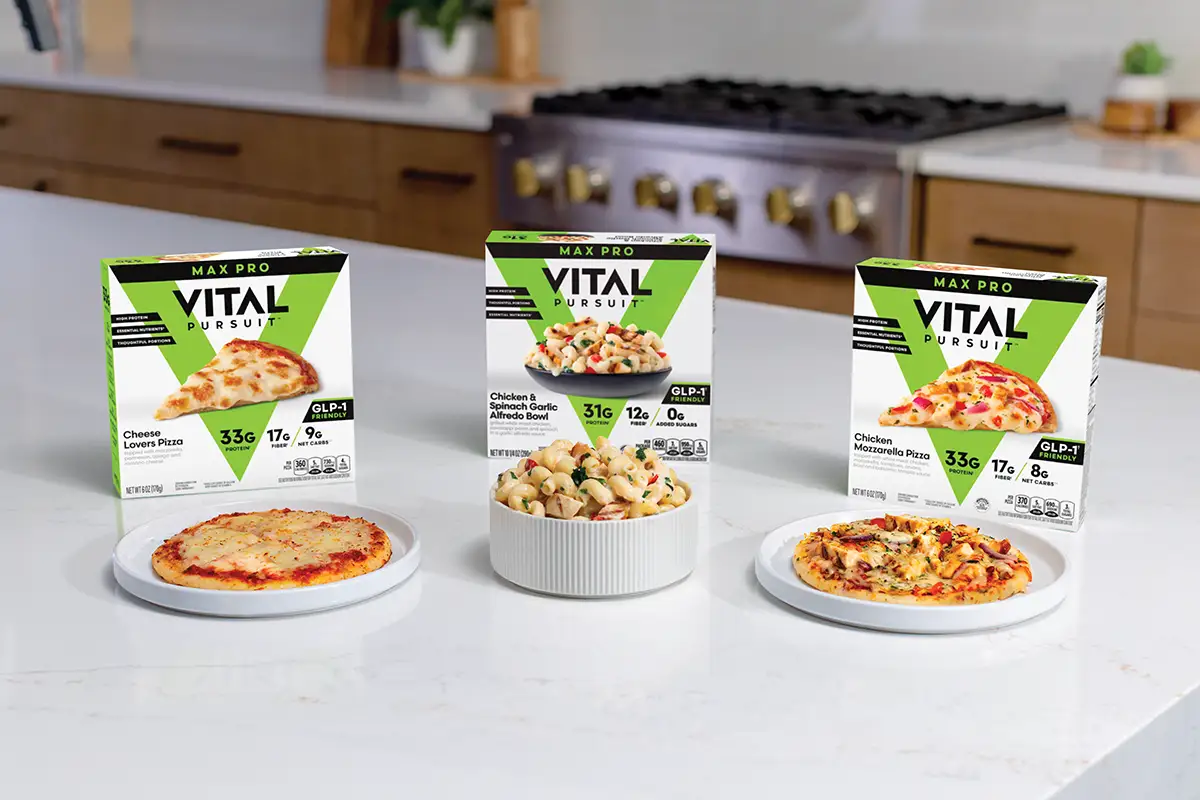
Some products flag products as “GLP-1 friendly” on the package, but Tahiri advises against it. She says the claim narrows the market to current users and invites regulatory and trust scrutiny. Instead, she recommends flagging protein, fiber, and nutrient density. “A credible nutrition cue travels everywhere,” she says.
GLP-1 Product Categories
The current wave of GLP-1-oriented innovation clusters into distinct categories:
Portion-Controlled, Nutrient-Dense Meals
Frozen entrees and ready-to-eat meals built around smaller portions with higher protein and fiber were among the first to market to GLP-1 users, including Nestlé’s Vital Pursuit. The line includes portion-controlled frozen pizzas, sandwich melts, and grain bowls.
Protein-Fiber Combinations
New products pair protein—to help preserve muscle—with fiber to support gut health and satiety. Danone’s Oikos Fusion is marketed as the first cultured dairy drink built specifically to address GLP-1 users’ nutrition gaps, combining higher protein with prebiotic fiber.
Compact and Clear Protein
To support smaller appetites, 100-kcal shots pack in 23 to 25 g protein. Clear Protein’s light, juice-like consistency is often easier to tolerate compared with thick, creamy textures when digestion is slowed by GLP-1s.
Functional Snacks and Bars
Expect to see more protein- and fiber-fortified snacks designed for smaller, more frequent nutrient-dense occasions.
Indulgences, Reimagined
GLP-1 users haven’t stopped wanting sweets, but they’re seeking intentional, single-serve bites—especially premium chocolate. Expect more functional indulgences with more protein and less sugar, and mini versions of ice cream and other sweets.
GlP-1 Support Supplements
A fast-growing companion category targets the protein and micronutrient gaps that may affect GLP-1 users. Others contain prebiotic fiber to support gut health.
— Janet Helm, MS, RDN, is the founder of Food at the Helm, a strategy and communications consultancy focused on food brands.
References
1. Montero A, Kearney A, Mulugeeta M, Kirzinger A, Hamel L. KFF health tracking poll: prescription drug costs, views on Trump administration actions, and GLP-1 use. https://www.kff.org/public-opinion/kff-health-tracking-poll-prescription-drug-costs-views-on-trump-administration-actions-and-glp-1-use/. Published November 1, 2025.
2. Hristakeva S, Liaukonytė J, Feler L. The no-hunger games: how GLP-1 medication adoption is changing consumer food demand. J Mark Res. 2026;63(3):427-444.
3. Awad K, Ehmke M, McCluskey JJ, Okrent A. GLP-1 medication adoption and household demand for ultra-processed foods. Paper presented at Allied Social Sciences Association 2026 Annual Meeting; January 5, 2026; Philadelphia, PA.
4. Dilley A, Adhikari S, Silwal P, Lusk JL, McFadden BR. Characteristics and food consumption for current, previous, and potential consumers of GLP-1s. Food Qual Prefer. 2025;129:105507.
5. Bina JD, Tonsor GT, Richards TJ. GLP-1 use and protein demand. Food Policy. 2026;138:103026.
6. Spreckley M, Ruggiero CF, Brown A. Nutrition strategies for next-generation incretin therapies: a systematic scoping review of the current evidence. Obesity Reviews. 2026;27(6):e70079.
7. Johnson B, Milstead M, Thomas O, et al. Investigating nutrient intake during use of glucagon-like peptide-1 receptor agonist: a cross-sectional study. Front Nutr. 2025;12:1566498.
8. Mozaffarian D, Agarwal M, Aggarwal M, et al. Nutritional priorities to support GLP-1 therapy for obesity: a joint Advisory from the American College of Lifestyle Medicine, the American Society for Nutrition, the Obesity Medicine Association, and The Obesity Society. Am J Clin Nutr. 2025;122(2):344-367.