




Today’s Dietitian
Vol. 28 No. 4 P. 16
The global weight management market was valued at $142.58 billion in 2022 and is projected to reach $298.66 billion by 2030. Morgan Stanley estimates the market for weight loss medications could grow to $150 billion worldwide by 2035.1 While originally used to treat diabetes, newer medications are now widely prescribed for the treatment of obesity, and they are transforming the weight management space.
Glucagonlike peptide-1 receptor agonists (GLP-1 RAs) make it easier for some patients to lose weight. Endogenously produced GLP-1 helps regulate insulin secretion, slows stomach emptying, and influences signals to the brain that promote fullness. GLP-1 RA medications mimic these effects. Newer weight loss medications may also target GIP (glucose-dependent insulinotropic polypeptide), another hormone involved in blood sugar regulation and appetite control. Together, these pathways help patients feel less hungry while supporting metabolic regulation.
Most of these medications are designed for long-term use, yet discontinuation is common. A recent cohort study found that about half of patients with diabetes and 64% without diabetes stopped GLP-1 medications within one year.2 While many patients with diabetes restart treatment, only 36% of those without diabetes do. Another systematic review and meta-analysis documents weight rebounding after discontinuation of GLP-1s, with 60% of the weight lost regained after one year.3 These statistics underscore a familiar truth: losing weight is one challenge; maintaining it is another.
While these medications are powerful tools, they do not replace foundational habits in the form of nutrition, physical activity, and other lifestyle-related behaviors impacting health. For patients who discontinue them, the return of “food noise” can make weight maintenance especially difficult. That transition requires more than willpower—it calls for a thoughtful plan that naturally mimics some of the medication’s appetite-regulating effects, while also supporting satiety, meeting nutritional needs, and modulating metabolic health across multiple fronts.
Weight Maintenance Requires a Different Plan
Dietitians are uniquely positioned to help patients shift from medication-supported appetite control to sustainable self-regulation by combining obesity medicine insights with practical, behavior-focused nutrition strategies. Once a patient goes off the medication, they are challenged with the return of food noise and increased hunger. According to obesity expert Holly Wyatt, MD, coauthor of Losing the Weight Loss Meds, the biggest hurdle is how quickly biology shifts after discontinuation.4
“Appetite comes back, hunger signals increase, and the body is already more efficient at conserving energy after weight loss. This is physiology doing exactly what it is designed to do,” she says.
Preparing patients for what lies ahead is essential for long-term weight maintenance. Wyatt emphasizes that the “weight maintenance phase is not passive” but rather a distinct stage requiring a different plan than weight loss itself. According to Wyatt, a successful long-term
weight maintenance plan depends on three interconnected strategies:
- reset the appetite;
- create a more “flexible” metabolism; and
- adopt an optimal mindset.
Creating the proper mindset for weight maintenance requires a switch from focusing on weight reduction to the lifelong maintenance of a steady range of weight. “What makes weight loss stick is not one behavior. It is building a system across these three areas so that appetite, metabolism, and mind state are all working with you instead of against you.”
Resetting the Appetite With Food
When weight loss medications are discontinued, appetite is not regulated externally. “You will feel like you are constantly fighting your body,” says Wyatt. She recommends building meals around what she calls “Food Plays”—strategic combinations of protein, fiber, and volume designed to increase fullness, stabilize hunger, and create greater consistency across the day. Protein supports satiety and muscle preservation, while fiber-rich plant foods add volume, support the microbiome, and help slow digestion so hunger does not return as quickly. Limiting highly processed foods and foods high in added sugar can further support this satiating, high-volume, higher-protein approach.
Create a Flexible Metabolism
“Metabolic flexibility is about restoring your body’s ability to move between using carbohydrate and fat, depending on what you are eating and how active you are,” Wyatt explains. After weight loss, the body may not switch between fuel sources as easily, making regular physical activity especially important. Consistent movement helps the body use calories more efficiently and better adapt to use both carbohydrate and fat for fuel. Helping patients identify realistic activities they can sustain each week is key to supporting metabolic flexibility.
Quick tips include:
- Focus on doable goals. Help patients create achievable activity targets, such as walking at least 6,000 steps a day or committing to an enjoyable activity three times a week.
- Encourage structure. Suggest scheduling movement on the same days each week using a calendar or phone reminders to build consistency.
- Redefine physical activity. Emphasize that movement includes more than traditional forms of exercise. Reducing sedentary time matters, too. Wyatt recommends cutting sitting time by 60 minutes per day to start, with simple strategies like standing up every 45 minutes to stretch, walk, or do toe touches.
- Create visual cues. Sticky notes, phone alarms, or other prompts can remind patients to move more throughout the day, whether that means a stretch break or a 10-minute walk outside.
Small changes in movement add up. As Wyatt notes, “When that system is working well, your body is more effective at using energy instead of storing it.”
Maintain an Optimal Mindset
Helping patients prepare for the challenges that often follow discontinuing weight loss medications can improve long-term success. Data from the National Weight Control Registry suggest that individuals who maintain weight loss over time tend to rely on consistent routines, physical activity, self-monitoring, and the ability to recover quickly from setbacks.5
Wyatt intentionally uses the term “mindstate” in her practice. It’s not just how patients think—it’s how they show up, respond to challenges, and manage their inner dialogue. A positive, flexible mindstate can play a critical role in whether patients maintain weight loss or regain it. As Wyatt explains, “When mindstate is working well, you are not rigid or all-or-nothing. You can be flexible, make choices, and still stay in control, and that is what allows this to be sustainable.” Guiding patients effectively can include the following:
- ask patients how they feel and what challenges they anticipate before discontinuing medication;
- prepare patients for the stronger hunger cues, increased cravings, and emotional shifts that they may experience after stopping medication;
- encourage patients to replace negative thoughts (“I can’t do this”) with more constructive ones (“I had a setback, but I can move forward and get back on track”);
- help patients build systems and a supportive mindstate that reinforce sustainable meal planning, physical activity, and lifestyle habits at their lower weight.
Tools for Transitioning Off GLP-1 Medications
As Wyatt emphasizes, successful weight maintenance after stopping GLP-1 medications depends on helping patients build practical tools for navigating everyday food choices.
Food and Function
When patients transition off these medications, dietitians can support their restructuring of habits. That is where Kevin Ryan, MS, PhD, food and consumer strategist and founder of Malachite Research, offers another useful lens. Across the wellness and weight management landscape, Ryan has observed a meaningful shift in how consumers view food. “Consumers are not only looking for snacks or meals that offer pleasure, but they’re also looking for function,” he says. In other words, consumers increasingly want food to do a job.
Ryan calls this shift “restorative treating.” In this framework, treats are not mindless indulgences, cheat foods, or rewards for “good” behavior. Instead, they become tools for physical, emotional, and behavioral maintenance. “A restorative treat delivers layered value. It satisfies an immediate craving while supporting long-term goals like wellness and identity,” Ryan explains.
Ryan describes this movement as the end of the old “virtue vs vice” model. For decades, wellness was often framed as virtuous because it was tied to discipline, restriction, and control, while treats were often viewed as problem behaviors or lapses. But Ryan has observed a post-COVID shift in which consumers increasingly expect foods—even treats—to honor their bodies, not betray them.
The RESET Framework
For patients using or discontinuing GLP-1 RAs or similar medications, restorative treating may be especially valuable. When food noise is reduced while on the medication, patients have an opportunity to stop viewing food as something to fear or use solely as a reward. When medications are discontinued, the restorative treating framework may help patients navigate the return of cravings with greater intention, helping to bridge the gap between medication-supported appetite suppression and long-term self-regulation.
To apply restorative treating to everyday life, Ryan developed the RESET framework—Real, Effective, Sensory, Everyday, Thoughtful. For dietitians, this framework may offer a practical way to help patients align food choices with both mindstate and appetite support during weight maintenance. Ryan explains, “Wellness used to be about subtraction (less sugar, less fat, less joy). Now it is about addition: adding function, benefits, and support.” In meal (including treat) planning, dietitians can guide patients with the below questions.
- Real: Does it include recognizable, nature-forward ingredients like fruit, nuts, dairy, or whole grains?
- Effective: What “job” does the food do? Does it support satiety, exercise recovery, sleep, mood, or energy?
- Sensory: Does it provide satisfying flavor and texture—spicy, tart, sour, chewy, crispy, crunchy, creamy, or jiggly—that enhances pleasure and satisfaction?
- Everyday: Can it become part of a daily ritual that supports structure during transitional moments, such as early morning, after work, or before bed?
- Thoughtful: What does the food represent, and how does it align with a patient’s goals, values, or identity?
For patients challenged by cravings after stopping medication, the RESET framework reframes treats as strategic tools—not mindless indulgences. “The snack stops being a ‘vice’ and starts being a tool that supports the body’s recovery,” Ryan says.
A Recipe for Long-Term Success
Successful long-term weight maintenance, on the other side of weight loss medications, must support resilience. As Wyatt notes, “The difference between success and regain is not whether challenges happen. It is how someone responds to the challenge.”
Long-term success may depend less on restriction and more on practical eating strategies that target specific challenges. Some of Wyatt’s Food Play strategies recommend pairing protein with carbohydrates, making the first meal of the day an appetite-reset meal, adding more plant foods into the diet, and planning and using satiety snacks when needed to handle cravings.
The following flavor-forward recipes translate those strategies into everyday practice while also reflecting Ryan’s restorative treating philosophy: using food as a strategic tool that’s both satisfying and supports appetite regulation.
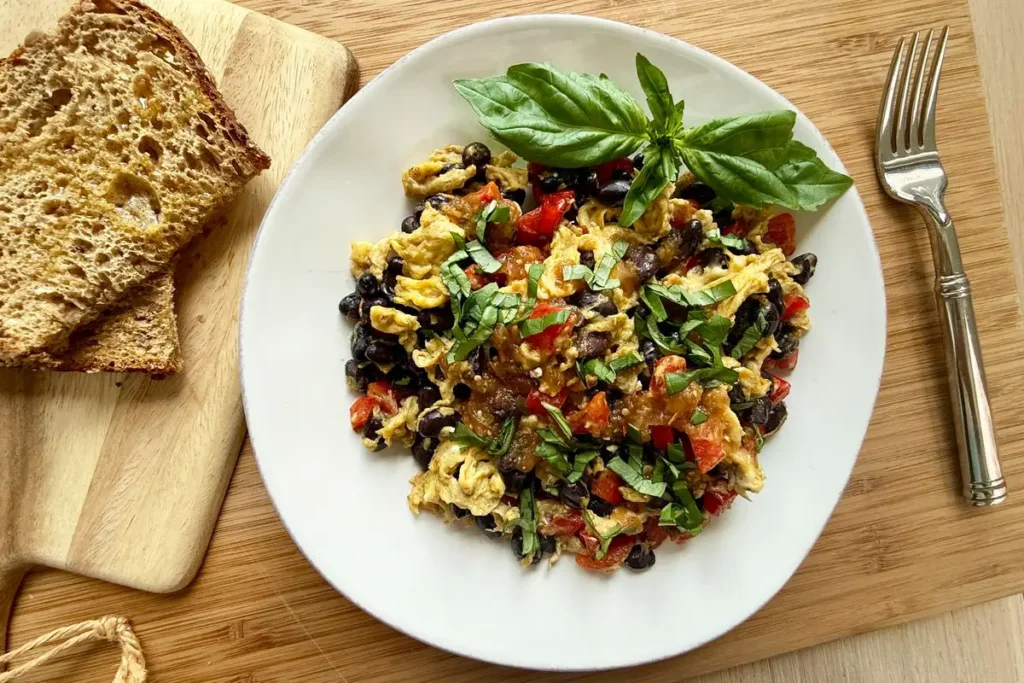
Bean and Bell Pepper Scramble
Yield: Serves 1
Total prep and cook time: 15 minutes
An appetite-reset breakfast sets the tone for the day. This savory scramble reflects Wyatt’s first-meal strategy by pairing protein, fiber, and volume to promote fullness and steadier appetite control (Wyatt specifically recommends at least 25 g protein, 15 g fiber, and 10 g fat for the morning appetite reset meal). Eggs and black beans deliver satisfying protein, while the fiber from the vegetables, beans, and bread add volume, digestive support, and staying power.
Ingredients
- Nonstick cooking spray
- ½ bell pepper, cut into ½-inch dice
- 2 large eggs, beaten
- ½ cup canned black beans, drained and rinsed
- 2 T low-fat shredded
- Cheddar cheese
- 1 T salsa
- 1 T chopped cilantro or other fresh herb, optional
- 1 slice toasted low-carb, high-fiber bread (we used Arnold brand)
Directions
- Coat nonstick skillet with cooking spray and heat over medium-low heat.
- Add bell pepper and cook, stirring often, until softened, 5 to 7 minutes.
- Add beaten eggs and beans, and cook, stirring gently and breaking up eggs until set, about 1 minute.
- Stir in cheese and cook until melted, 20 to 30 seconds. Remove from heat. Top with salsa and herbs, as desired. Serve with toasted bread.
Nutrient Analysis per serving (1 egg scramble)
Calories: 360; Total fat: 14.5 g; Sat fat: 5 g; Cholesterol: 380 mg; Sodium: 680 mg; Total carbohydrate: 37 g; Total sugars: 3 g; Added sugars: 0 g; Dietary fiber: 17 g; Protein: 29 g
NOTE: For a lower-fat option, use 1 whole egg and 1 egg white in place of 2 whole eggs. This reduces calories to 325 and total fat to 10 g, while still providing about 27 g protein.
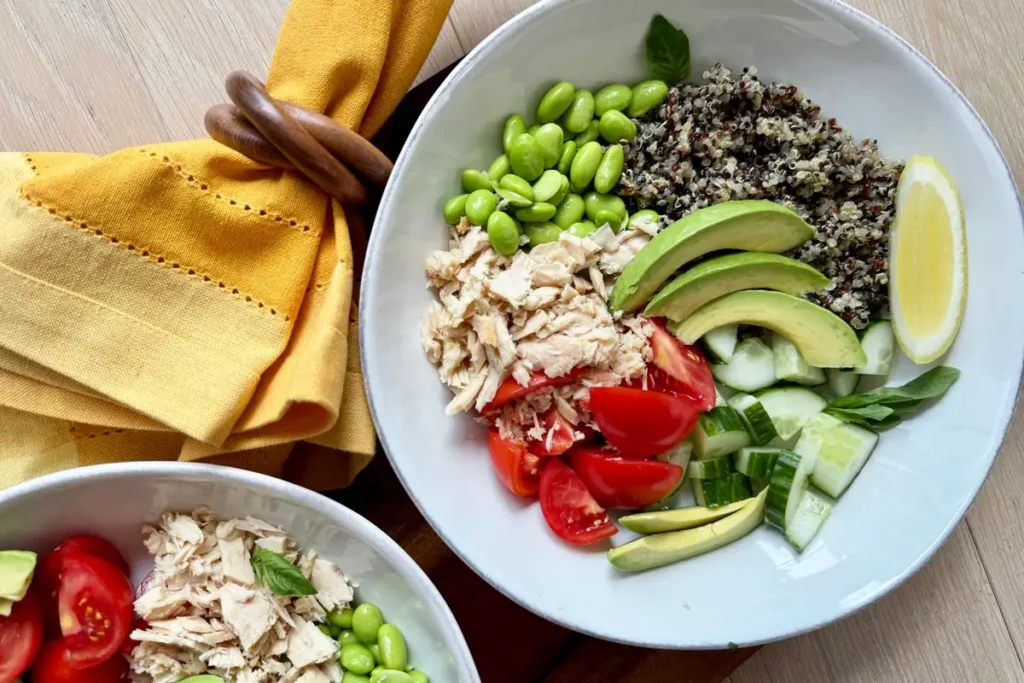
Tuna, Quinoa, and Veggie Bowls
Yield: Serves 2
Total prep and cook time: 20 minutes
Wyatt encourages patients to work toward eating 20 different plant-based foods each day—a “Food Play” designed to increase fiber and micronutrient intake, lower energy density, and support a healthier gut microbiome, all of which can play a role in appetite regulation after GLP-1 medications. For omnivores, this doesn’t mean giving up favorite protein foods, Instead, it provides an opportunity to add a variety of plants into more meals.
Ingredients
- 1 (5oz) can albacore tuna packed in water, drained and flaked
- 1 cup cooked quinoa
- One 3-inch piece English cucumber, cut into ½-in dice (¾ cup)
- 4 cocktail tomatoes, cut into quarters (1 cup) or 1 cup halved cherry or grape tomatoes
- ⅔ cup shelled edamame
- ½ ripe avocado, pitted and sliced or diced
- 1 T olive oil
- 1 T lemon juice
- 1 T chopped fresh basil or 1 tsp dried basil
- ½ tsp honey, plus more to taste
- ½ tsp Dijon mustard
- Pinch dried garlic, plus more to taste
- Salt and pepper
Directions
- Arrange tuna, quinoa, cucumber, tomatoes, edamame, and avocado evenly in two salad bowls.
- To make dressing, place oil, lemon juice, basil, honey, mustard, and garlic in mason jar with tight-fitting lid. Shake to combine. Taste and adjust flavor with salt, pepper, and additional honey and garlic powder, as desired.
- Top each salad with dressing. Taste salad and adjust with additional salt, pepper, or lemon juice.
Nutrient Analysis per serving (1 salad)
Calories: 395; Total fat: 17 g; Sat fat: 2.5 g; Cholesterol: 25 mg; Sodium: 240 mg; Total carbohydrate: 35 g; Total sugars: 6.5 g; Added sugars: 1.5 g; Dietary fiber: 9 g; Protein: 28 g
Chocolaty Cottage Cheese Whip

Yield: Serves 1
Total prep and cook time: 10 minutes
This protein-rich snack reflects Wyatt’s “Play” of planning for cravings before they derail progress (Wyatt recommends at least 25 g protein). At the same time, it embodies Ryan’s restorative treating philosophy by transforming a sweet snack into something functional (appetite control), that easily fits into an “everyday” routine. Creamy whipped cottage cheese provides the protein base, while cocoa and a touch of maple deliver chocolatey comfort. Chewy tart cherries and crunchy pecans layer in sensory contrast—sweet, tart, creamy, and crunchy—bringing Ryan’s RESET framework to life by pairing appetite control with restorative texture, flavor, and everyday pleasure.
Ingredients
- ½ cup low-fat cottage cheese
- 4 tsp low-fat milk
- 1 scoop plain plant-based protein powder
- 1 tsp unsweetened cocoa powder
- 1 tsp maple syrup, plus more to taste
- ½ teaspoon vanilla extract
- Sprinkle ground cinnamon
- Topping: 1T tart dried cherries, 1T pecan pieces, plus more to taste
Directions
- Place cottage cheese, milk, protein powder, cocoa powder, maple syrup, vanilla extract, and cinnamon, in bowl of mini food processor. Process until smooth and creamy, stopping a few times to scrape down sides of bowl. Taste and adjust flavor with 1 more teaspoon maple syrup, as desired.
- Transfer mixture to small serving bowl and top with dried cherries and pecans. Serve with additional dried cherries and pecans, as desired.
Nutrient Analysis per serving (½ cup)
Calories: 265; Total fat: 9 g; Sat fat: 2.5 g; Cholesterol: 10 mg; Sodium: 510 mg; Total carbohydrate: 31 g; Total sugars: 19 g; Added sugars: 6.5 g; Dietary fiber: 5 g; Protein: 25 g
— Liz Weiss, MS, RDN, shares recipes and healthful living advice on LizsHealthyTable.com and her podcast, EAT, DRINK, LIVE LONGER. Weiss is a cooking instructor, frequent lifestyle guest on TV shows across the country, and a recipe developer and cookbook author.
— Rosanne Rust, MS, RDN, is an award-winning dietitian, author, blogger, and the creator of Chew the Facts®. She has served as a nutrition advisor to agricultural and commodity boards and the food service industry. She’s been crafting food and nutrition messages for over 30 years and has written several books, including The GLP-1 Kitchen, DASH Diet For Dummies®, and Zero Waste Cooking For Dummies®. Find her on TikTok, Instagram, and Twitter @chewthefacts, or visit her website at www.rustnutrition.com.
References
1. The exponential growth of obesity drugs. Morgan Stanley website. www.morganstanley.com/insights/articles/weight-loss-medication-market-unstoppable-growth. Published May 9, 2025.
2. Rodriguez PJ, Zhang V, Gratzl S, et al. Discontinuation and reinitiation of dual-labeled GLP-1 receptor agonists among US adults with overweight or obesity. JAMA Netw Open. 2025;8(1):e2457349.
3. Budini B, Luo S, Tam M, et al. Trajectory of weight regain after cessation of GLP-1 receptor agonists: a systematic review and nonlinear meta-regression. eClinicalMedicine. 2026;93:103796.
4. Wyatt HR, Hill JO. Losing the Weight Loss Meds. Simon and Schuster; 2025.
5. The National Weight Control Registry website. http://www.nwcr.ws/