



Today’s Dietitian
Vol. 28 No. 5 P. 12
Body composition assessment is now routine in sports, sports medicine, and nutrition. It’s used to monitor training adaptations, rehab, nutrition strategies, and readiness. Interest has grown with the rise of wearables and social media, but body fat percentage alone offers limited insight into health or performance. There’s no universal “ideal” physique; two athletes with similar profiles may differ greatly in recovery, hormones, energy, or psychological factors.1
Leanness pressure is prevalent in certain sports and can lead to body dissatisfaction, compulsive monitoring, low energy availability (LEA), or relative energy deficiency in sport (RED-S) REDs.1,2 While body composition science has expanded to measure tissue distribution, bone density, and muscle quality, many methods still rely on equations that may not generalize well to athletes. Thus, body composition is only valuable when contextualized by hydration, glycogen, menstrual cycle, inflammation, or training status. It’s not about the number; it’s about its meaning for that athlete.
Common Methods of Body Composition Assessment
• Dual X-ray absorptiometry (DXA) is considered one of the most comprehensive field methods, estimating fat mass, lean mass, bone mineral content, and regional composition in a quick, low-radiation scan. It’s particularly useful for monitoring rehabilitation, asymmetries, or bone mineral density in athletes at risk for LEA, REDs, or stress fractures.3
• Air displacement plethysmography (Bod Pod) estimates body composition using body volume and density, offering a fast, noninvasive option, though it lacks regional or bone-density data.4
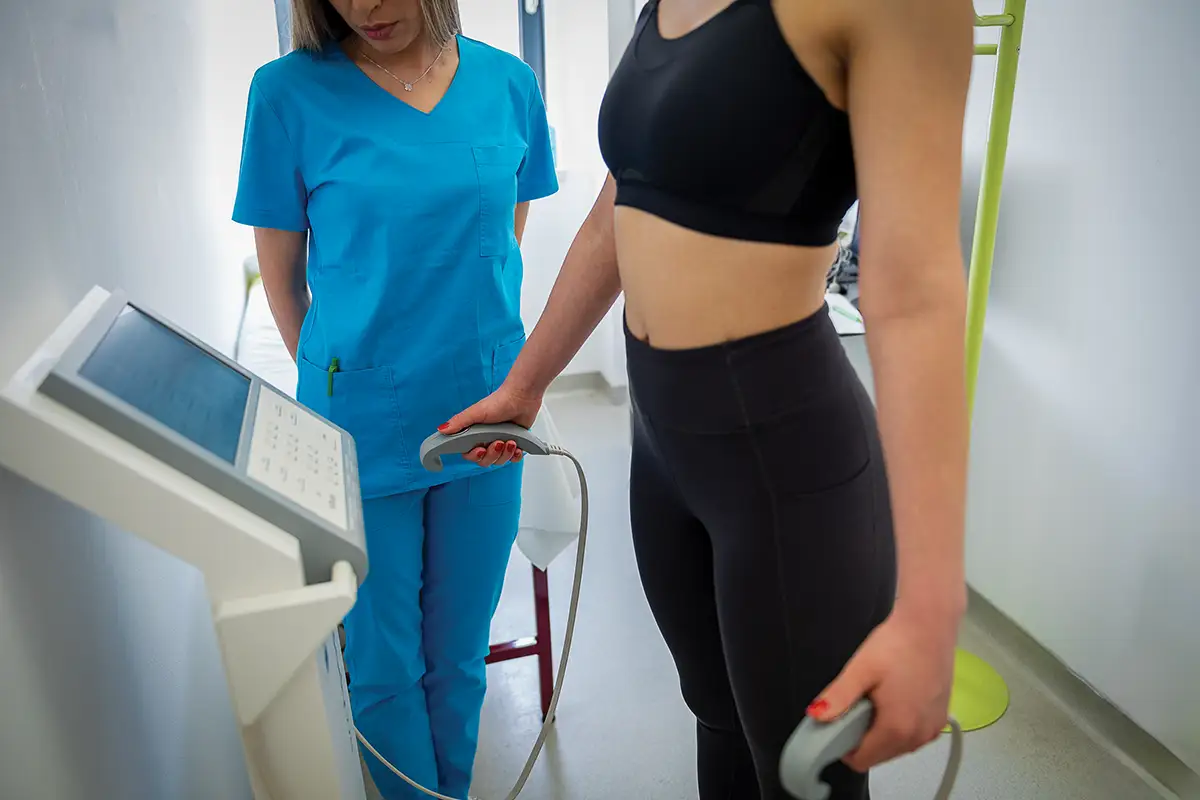
• Bioelectrical impedance analysis (BIA) estimates body composition based on electrical conductivity and is widely used for its portability, affordability, and integration with smart devices.5
• Skinfolds measure subcutaneous fat with calipers and prediction equations. It remains popular due to low cost and portability, and some reviews suggest it may be less affected by acute fluctuations when performed by experienced practitioners.6
Shared Limitations
All methods have limitations. Results can be affected by hydration, glycogen, recent exercise, inflammation, positioning, clothing, and technician skill. Small changes in conditions can alter results, independent of true tissue adaptation.3,4,5 Thus, body composition is best used to monitor trends under standardized conditions rather than as an isolated measure. Always interpret results within a broader clinical and performance context.
Choosing the Right Tool: Context, Ethics, and Athlete Well-Being
No body composition method is universally “best.” The appropriate assessment depends on the clinical question, athlete population, and whether results will meaningfully influence care. It can be useful for monitoring rehab, bone density in REDs risk, or broad responses to interventions. Yet body composition alone doesn’t predict performance, and no universal “ideal” physique exists.1
Ethical and Psychological Considerations
The psychological impact deserves as much attention as the physiological. Weight-focused sport environments increase the risk of body dissatisfaction, disordered eating, compulsive exercise, LEA, and REDs.2 Sport-specific pressures, including the “drive for leanness,” can worsen disordered eating symptoms.7 Even well-meaning practices, such as public weigh-ins, posting body fat percentages, or equating thinness with discipline, can cause shame, comparison, and loss of trust. International Olympic Committee (IOC) guidelines emphasize that inappropriate body composition practices heighten risks of LEA, REDs, and long-term health issues.1
Body composition data should support athlete care, not define athlete worth. Results should be interpreted alongside recovery status, mental health, laboratory data, and performance outcomes rather than in isolation.1,2
The Future of Athlete Assessment
Athletes now have access to extensive physiological data via wearables: smartwatches, rings, glucose monitors, GPS devices, recovery apps, and body composition analysis. These tools offer insights into sleep, heart rate variability, training load, and glucose trends, but their accuracy is influenced by the algorithms used, hydration, recent exercise, and individual physiology. Thus, wearables are most valuable for tracking patterns over time. No single metric captures readiness, so multivariable monitoring is preferred.8 Body composition and recovery data should be interpreted alongside nutrition, training, mental health, labs, injury history and symptoms, and performance outcomes.1,2
Beyond Body Composition: Biomarkers and Individualization
Athlete monitoring is increasingly personalized. Clinicians now use biomarkers such as iron status (eg, ferritin levels), hormonal function (including cortisol, testosterone, or estrogen), inflammatory markers (such as C-reactive protein or interleukin-6), and recovery physiology (eg, heart rate variability, creatine kinase levels, or sleep efficiency). These biomarkers, longitudinally assessed, help identify adaptation, recovery, and potential stress when interpreted within the athlete’s broader clinical context.8
Advances in sports genomics add another layer. Over 250 DNA polymorphisms are associated with athletic traits, though no single genetic profile predicts elite performance.9 Individualization, based on biomarkers, genetics, and clinical context, offers a more complete picture of athlete health.
AI and the Shift Toward Function
Artificial intelligence is integrating into sports science, aiding data analysis, injury monitoring, and pattern recognition. Yet caution is needed as AI may introduce biases or reduce human oversight. Successful use requires human-AI collaboration, not replacement of practitioner judgment.10
Ultimately, body composition alone is insufficient. The future will emphasize functional markers such as muscle quality, recovery readiness, and resilience, aligning with REDs recommendations focused on athlete well-being.2
The Takeaway
Body composition assessment can provide useful insight into an athlete’s health, recovery, adaptation, and performance, but no method is perfect. The most valuable assessment is not necessarily the most advanced technology, but the one that provides meaningful, actionable information in an appropriate clinical and performance context.
When testing is appropriate, consistency and context matter. Many body composition methods are sensitive to hydration status, glycogen fluctuations, recent exercise, food intake, inflammation, and menstrual cycle phase. Without standardized conditions, small changes over time may reflect normal physiological variability rather than true tissue adaptation. Whenever possible, clinicians should use the same device and protocol consistently, standardize preparation instructions, avoid unnecessary testing, and focus on longitudinal trends rather than isolated values.
As access to body-composition and wearable data continues to expand, clinicians must avoid overinterpreting isolated numbers or allowing physique-based metrics to overshadow broader indicators of health and performance. Sports nutrition professionals are uniquely positioned to interpret these data responsibly, protect athlete well-being, and balance performance goals with long-term health.
In athlete care, the goal should never be to chase a number, but to support resilient, healthy, high-performing humans.
— Krissy Ladner-Lines, DHSc, MS, RD, CSSD, CPT, is a sports dietitian and sports performance director with nearly 20 years of experience in nutrition and sports medicine. She is a media-trained dietitian, adjunct lecturer, and membership director for WISE San Diego. Based in San Diego, she supports athletes globally across performance, nutrition, and body image initiatives.
Practical Tips
Before performing any body composition assessment, clinicians should first determine whether the information will meaningfully influence care, programming, or decision-making. In many cases, the most important question is not which testing method is most advanced, but whether testing is necessary at all. Useful questions to ask before testing include:
• Why are we testing?
• Will the results change clinical care or performance strategy?
• Is this the appropriate timing physiologically and psychologically?
• Is the athlete comfortable with the assessment?
• Which method best answers the question being asked?
These considerations become especially important in athletes with a history of disordered eating, compulsive exercise behaviors, body image concerns, or REDs risk, where testing may unintentionally create more harm than benefit.
References
1. Mathisen TF, Ackland T, Burke LM, et al. Best practice recommendations for body composition considerations in sport to reduce health and performance risks: a critical review, original survey and expert opinion by a subgroup of the IOC consensus on Relative Energy Deficiency in Sport (REDs). Br J Sports Med. 2023;57(17):1148-1158.
2. Mountjoy M, Ackerman KE, Bailey DM, et al. 2023 International Olympic Committee’s (IOC) consensus statement on Relative Energy Deficiency in Sport (REDs). Br J Sports Med. 2023;57(17):1073-1097.
3. Nana A, Slater GJ, Stewart AD, Burke LM. Methodology review: using dual-energy X-ray absorptiometry (DXA) for the assessment of body composition in athletes and active people. Int J Sport Nutr Exerc Metab. 2015;25(2):198-215.
4. Muntean P, Popa A, Miclos-Balica M, et al. Learning effects in air displacement plethysmography. Life (Basel). 2023;13(6):1315.
5. Campa F, Coratella G, Cerullo G, et al. High-standard predictive equations for estimating body composition using bioelectrical impedance analysis: a systematic review. J Transl Med. 2024;22(1):515.
6. Kasper AM, Langan-Evans C, Hudson JF, et al. Come back skinfolds, all is forgiven: a narrative review of the efficacy of common body composition methods in applied sports practice. Nutrients. 2021;13(4):1075.
7. Fatt SJ, Hay P, George E, Jeacocke N, Rogers K, Mitchison D. Function over form: a longitudinal study of predictors and mediation pathways for disordered eating in elite athletes. Sports Med Open. 2025;11(1):113.
8. Kellmann M, Bertollo M, Bosquet L, et al. Recovery and performance in sport: consensus statement. Int J Sports Physiol Perform. 2018;13(2):240-245.
9. Semenova EA, Hall ECR, Ahmetov II. Genes and athletic performance: the 2023 update. Genes (Basel). 2023;14(6):1235.
10. Naughton M, Salmon PM, Compton HR, McLean S. Challenges and opportunities of artificial intelligence implementation within sports science and sports medicine teams. Front Sports Act Living. 2024;6:1332427.