




Today’s Dietitian
Vol. 28 No. 3 P. 32
Did you know that elevated carbon dioxide in the atmosphere may lead to decreasing content of essential micronutrients in many common foods? Among the numerous connections between food production and climate, evidence suggests that elevated carbon dioxide reduces nutrients such as carotenoids, zinc, and iron in some crops.1
Climate change may also impair overall yields of many row crops and specialty crops (including worsening drought and heat and driving pollinator loss), coastal rice and fishery production (through flooding), and ocean fishery production (through warming waters), among other negative impacts. These effects are concerning for human nutrition and food security, necessitating both education for health care professionals about meeting nutritional needs and policy change to support a more resilient food system.
Agriculture and Climate Change
As US farmers prepare for spring planting each year, they must make decisions based on the challenges of increasingly extreme and unpredictable weather patterns. The 2024 Global Climate Report showed that the global average surface temperature was 2.32°F above the 20th-century average, and it was the warmest year since global records began in 1850.2 Scientists say this warming trajectory can only change with a drastic cut in domestic and global carbon emissions.3
A multitude of factors—including food production—contribute to greenhouse gas emissions that negatively impact environmental and human health. Agricultural production undoubtedly impacts climate change, just as climate change, in turn, directly impacts agriculture.
Effects of Agriculture on Climate Change
In 2023, agriculture accounted for more than 10% of US greenhouse gas emissions (649.6 million metric tons of carbon dioxide equivalent) (See Figure 1).4,5
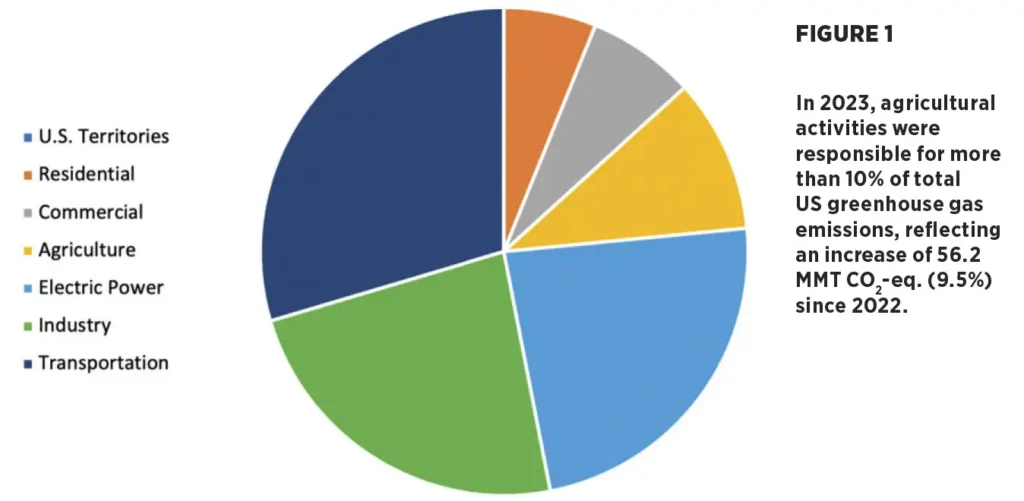
Increased carbon dioxide, nitrous oxide, and methane emissions are unfavorable consequences of industrialized agriculture and movement away from noncommercial, subsistence farming practices intended to meet the basic needs of producers and their families. Industrialized agriculture prioritizes efficiency over resilience, heavily subsidizes the overproduction of monoculture crops, and disproportionately directs funds toward large-scale animal factories (also known as concentrated animal feeding operations, or CAFOs).
Although monocropping and factory farming were originally initiated to expand the global food supply, over time, these practices have contributed to significant environmental harm. Despite their original intent, they have led to increased pollution and long-lasting ecological damage, including the following concerns:6,7
- soil erosion, acidification, and degradation;
- air and water pollution from animal waste;
- reduced biodiversity;
- toxic residue from pesticides, herbicides, and other chemical applications; and
- antibiotic resistance.
Effects of Climate Change on Agriculture
Extreme weather patterns and changes in the seasonal distribution of precipitation can devastate agriculture, threatening the quality, safety, and security of our national and global food supply. Changing climatic conditions are also expected to reduce the nutritional quality of crops we grow and consume every day. As a result, strategies like genetic engineering have been proposed to improve nutrient content, increase yields, and enhance stress tolerance to support crop resilience in changing environments. This technology is not the only possible solution, however, and has drawbacks like the potential for increased weed and insect resistance.
Climate-smart farming practices like crop rotation and intercropping are also critical for agricultural resilience and help attenuate potential negative environmental impacts and the effects of climate change on agricultural productivity. Encouraging and rewarding farmers to implement sustainable farming practices like cover cropping, contour farming, and conservation tillage can help to prioritize climate change mitigation.
Support for sustainable agriculture comes in many forms, including through federal programs. Thus, US food and farming policy plays an important role in determining what foods farmers grow and how they grow them, the foods that we purchase and consume, and the health outcomes that result.
Policy Solutions: Past and Future
Food and agriculture policy in the US has changed substantially in the past couple of years. From the new Dietary Guidelines for Americans to increasing state-level policies restricting the use of food additives to a major restructuring of the typical farm bill reauthorization process—and even a major restructuring of the USDA—farmers and consumers alike are striving to navigate this rapidly changing landscape. In the meantime, the implications for human and environmental health are as important as ever. Opportunities for promoting agricultural resilience through several relevant recent or ongoing policies and programs are presented below.
Farm Bill
US food and agricultural policy is largely reflected by the farm bill—our nation’s largest and most comprehensive package of programs related to food access, farm supports, forestry, and conservation programs. Its conservation programs are important for promoting agriculture resilience, and most of the conservation programs in the farm bill are guaranteed funding. However, these funds are often the first to be cut due to revised budgets and changes in farm bill funding priorities, despite their importance to our nation’s food security and agricultural resilience.
This massive, complex piece of legislation is currently overdue for reauthorization, which happens roughly every five years. In 2025, the typical reauthorization process changed as the largest programs funded by the farm bill (primarily including SNAP, commodity subsidies, and crop insurance subsidies) were funded through the 2025 One Big Beautiful Bill. This approach left remaining farm bill programs (including many in conservation and specialty/local crop production and marketing) awaiting some semblance of reauthorization for later in 2026.
Amid other recent policy changes that may negatively affect small and local producers from reaching and fairly competing in their target markets—such as the 2025 termination of the Local Food Purchase Assistance Program (authorized by the American Rescue Plan in 2021)—this is a timely opportunity to ensure funding is directed toward programs that specifically support resilience of local food systems. The next farm bill reauthorization can strengthen and expand conservation practices on US farmland by mandating conservation compliance for taxpayer-funded crops or receipt of revenue insurance and increasing farmland acreage enrolled in the Conservation Reserve Program.
Agriculture Resilience Act
Positive changes to the farm bill can also be made incrementally by introducing marker bills. While such marker bills do not generally become law as standalone bills, they may be incorporated into an omnibus bill (or a large legislative package that combines numerous smaller bills, like the farm bill) and help to promote policy ideas and gather support for those ideas. One example is the Agriculture Resilience Act (ARA) of 2025 (H.R. 3077/S. 1507), which was reintroduced to Congress in April 2025.8
This 12-title bill offers a farmer-driven approach to climate change based on scientific solutions and aims to achieve net-zero greenhouse gas emissions in agriculture by the end of 2040. Examples of tactics to reach this goal include the following:8
- increased research on agroforestry, perennial production systems, and other areas;
- improvements in soil health through expanding adoption of cover cropping, composting, and other practices;
- reduction in the rate of converting agricultural land to development and of grassland to cropping;
- enhancing pasture management of livestock;
- reduction of on-farm energy use and implementation of renewable energy systems; and
- reduction of food waste by creating better food labeling, donation practices, and composting systems.
According to the National Sustainable Agriculture Coalition (NSAC),9 the ARA can help to adapt the farm bill to the current reality by ensuring conservation, research, renewable energy, and rural economic development programs that empower farmers and ranchers who are eager to drive climate solutions on the ground.
Domestic Organic Investment Act of 2025
Beyond the farm bill, various other pieces of legislation also direct what food is grown and how its production affects the environment in the US. Introduced in late 2025, The Domestic Organic Investment Act (H.R. 6593/S. 3427) would strengthen the domestic organic product supply chain by enhancing the capacity of producers via projects such as expanding storage, processing, aggregation, and distribution capabilities for their products.10 Organic agriculture does not use synthetic chemicals and helps to maintain or improve soil health—which can translate to improved long-term health of individuals and communities. Organic agriculture has higher up-front costs for producers, so this funding would help to lower potential cost barriers and increase demand and utilization for these systems, while reducing our reliance on imports.
USDA Regenerative Pilot Program
In December 2025, USDA announced a $700 million Regenerative Pilot Program to help farmers implement practices that improve soil health, water quality, and long-term productivity11—well-aligned with the concept of resilience. While not a new piece of legislation or program, this pilot will focus on whole-farm planning by dedicating $400 million for projects funded by two long-standing farm bill conservation programs. These earmarked funds will help farmers transition to regenerative agriculture, regardless of their starting point. While it is a small amount of funding relative to overall agricultural subsidies, this pilot represents a promising step for USDA to prioritize resilience in our food system and health for American consumers.
Why Agriculture Resilience Matters
Agriculture is part of a complex and multifaceted food system that is inextricably linked to nutrition security and human health. For this reason, agricultural resilience is essential in today’s climate crisis, where our food supply’s quantity, quality, and stability are at risk.
Innovation, adaptation, and adoption of climate-smart farming practices can help protect vital natural resources and crop production, thereby reducing the negative repercussions of climate change. Fundamentally, agricultural resilience requires a transition from conventional commodity monocropping toward tactics like rotational farming and crop diversification. Additionally, agricultural resilience promotes increased economic stability and reliance on domestic food sources, improving Americans’ nutrition security.
Everyday Ways to Promote Positive Change
Education and advocacy are everyday ways that nutrition professionals can promote positive change in our food system. We know that air, soil, and water quality directly impacts our food supply. Amid farm bill negotiations and funding considerations for conservation and climate programs, food and nutrition professionals are poised to make a difference as trusted and expert sources of information about diet and how food can either support human health or perpetuate diet-related chronic illness.
Now is the perfect time to encourage policymakers to invest in climate and conservation policy efforts that reward conservation stewardship efforts and farmers who follow basic environmental standards and climate-smart farming practices. Multiple organizations, like RAFI-USA and NSAC, make it easy with ready-made action alerts that can be easily tailored to ask Congressional representatives to support these efforts.
Just like our patients, clients, and colleagues, nutrition professionals are consumers who need to eat. Purchasing food products from small family farms and markets helps to keep them in business and supports the local economy. Buying from local farmers also promotes seasonal eating, which helps to decrease the carbon footprints of our diets by reducing transportation (including imports from other countries) and storage and possibly lowering human and environmental exposure to agrochemicals.
This impact is even more substantial for professionals in roles that direct or influence large-scale food purchasing (such as for schools, large employers, or hospitals). Nutrition professionals leading food service operations or food is medicine programs (such as produce prescriptions or culinary medicine programs) can prioritize sourcing food that is produced locally and regeneratively to not only benefit the consumers’ health, but the health and resilience of their broader communities. Consider looking for a food hub in your region that helps to aggregate food from various farms and has capacity to provide the diverse types of foods at the scale your organization may need.
“Working with food hubs can help to facilitate integration of clinically tailored nutrition interventions with values-based food sourcing and distribution networks,” says Tom McDougall, CEO and founder of 4P Foods in Virginia. “Whether working in hospitals, outpatient clinics, community health centers, corporate wellness programs, private practice, or public health settings, dietitians can engage with food hubs in their regions to explore pilot programs, referral pathways, or codesigned interventions that help to transform food access systems into integrated extensions of preventive and therapeutic care—benefiting the health and resilience of individual patients as well as broader communities.”
Those working in population health can also prioritize spending through community benefits programs to benefit the larger community. They can design food programs to support local and regenerative farms, plan initiatives to educate the community and better connect them with local resources, and design programs to minimize exposure to chemicals and maximize resilience of supply chains.
Finally, the diverse expertise of nutritional professionals allows for broad reach. We can spread the word as researchers, food and public health educators, food service managers, health coaches, clinicians, policymakers, thought leaders, and other positions.
“RDNs are trusted messengers who influence both individual choices and institutional decisions, from patient counseling to procurement and policy conversations,” says Mary Purdy, managing director of the Nutrient Density Initiative and adjunct faculty at the Culinary Institute of America. “That combination of scientific credibility and real-world decision-making power positions us to champion farming approaches that support resilience, sustainability, and better nutrition for all.”
You can be prepared to pass along information from the Environmental Working Group, NSAC, Environmental and Energy Study Institute, and other organizations to inform interested audiences. Readers may even be able to engage with these food and farm policy and program resources to support and inform their own work.
— Christina Badaracco, MPH, RDN, LDN, regularly writes and teaches about nutrition, culinary medicine, and sustainable agriculture—including coauthoring The Farm Bill: A Citizen’s Guide and educating health care providers about how to effect positive change. She works as a health care consultant, supporting clients in evidence generation, policy interpretation, and strategic planning. She is particularly focused on advancing food is medicine and culinary medicine interventions and research across the health care system.
— Niki Randolph, MS, RDN, CISSN, is a clinical dietitian at AdventHealth Avista in Colorado and represents the Colorado Academy of Nutrition and Dietetics on the Food Is Medicine Colorado Coalition. Randolph is passionate about delivering compassionate, evidence-based care as part of a dedicated multidisciplinary team and strives to connect patients to local growers and community-based food resources. She remains committed to advocating for positive change in our food and farming system.
References
1. Semba RD, Askari S, Gibson S, Bloem MW, Kraemer K. The potential impact of climate change on the micronutrient-rich food supply. Adv Nutr. 2022;13(1):80-100.
2. Annual 2024 Global Climate Report. National Centers for Environmental Information website. https://www.ncei.noaa.gov/access/monitoring/monthly-report/global/202413. Published 2024.
3. Our climate change crisis. ScienceNews website. https://www.sciencenews.org/century/climate-change-carbon-dioxide-greenhouse-gas-emissions-global-warming. Published March 10, 2022.
4. Inventory of U.S. Greenhouse Gas Emissions and Sinks: 1990-2023. U.S. Environmental Protection Agency. https://library.edf.org/AssetLink/145ky510ew61fk1tq5c2klp5kq5yp33j.pdf. 430-R-25-003. Published 2025.
5. Inventory of U.S. Greenhouse Gas Emissions and Sinks: 1990-2022. U.S. Environmental Protection Agency website. https://www.epa.gov/ghgemissions/inventory-us-greenhouse-gas-emissions-and-sinks-1990-2022. Published February 8, 2024.
6. Imhoff D, Badaracco C. The Farm Bill: A Citizen’s Guide. Washington, DC: Island Press; 2019.
7. Robbins O. Monocropping: a disastrous agricultural system. Food Revolution Network website. https://foodrevolution.org/blog/monocropping-monoculture/. Published March 18, 2022.
8. Agriculture Resilience Act of 2025, H.R. 3077, 119th Congress (2025-2026). https://www.congress.gov/bill/119th-congress/house-bill/3077
9. Release: agriculture resilience act advances bold, farmer-driven vision. National Sustainable Agriculture Coalition website. https://sustainableagriculture.net/blog/release-agriculture-resilience-act-advances-bold-farmer-driven-vision/. Published April 22, 2025.
10. Domestic Organic Investment Act of 2025, H.R. 6593, 119th Congress (2025-2026). https://www.congress.gov/bill/119th-congress/house-bill/6593
11. USDA Launches New Regenerative Pilot Program to Lower Farmer Production Costs and Advance MAHA Agenda. U.S. Department of Agriculture website. https://www.usda.gov/about-usda/news/press-releases/2025/12/10/usda-launches-new-regenerative-pilot-program-lower-farmer-production-costs-and-advance-maha-agenda. Published December 10, 2025.