



Today’s Dietitian
Vol. 28 No. 2 P. 20
As the “silver tsunami” continues to reshape demographics, prioritizing the cognitive well-being of older adults has become increasingly vital.1 Adults aged 65 years and older now represent more than 17% of Americans, and this group is projected to grow by nearly 30% over the next 25 years.2,3
With longevity on the rise, health care priorities are shifting from simply extending lifespan to enhancing quality of life, particularly by supporting cognitive health. Alzheimer’s disease currently affects nearly 7 million Americans, and dementia rates are projected to reach 131 million globally by 2050.2 A proactive approach to preserving cognition has never been more essential.
Supporting cognitive health and function is key to preserving autonomy, dignity, and vitality with age.1 For dietitians, one of the most powerful (and often overlooked) ways to promote cognitive wellness lies in the dining experience itself.
The Connection Between Patient Experience and Cognitive Health
To design environments that promote cognitive well-being, it is important to understand what “patient experience” truly means. The Beryl Institute defines it as, “the sum of all interactions, shaped by an organization’s culture, that influence patient perceptions across the continuum of care.”4
Positive patient experience isn’t just a matter of satisfaction surveys; it’s a cornerstone of quality care. Key pillars include quality and safety of care, effective communication, accessibility, and a comfortable, supportive environment.5
When older adults feel informed and empowered in their care, the benefits extend beyond satisfaction.6,7 Research shows that autonomy, dignity, and participation in decision-making are linked to slower cognitive decline.8,9 In other words, the way care is delivered, and the environment in which it occurs, can directly influence cognitive outcomes.10
Taking inspiration from what poet Maya Angelou says, “People will forget what you said, people will forget what you did, but people will never forget how you made them feel.” This is particularly true in senior living communities. Residents who feel heard and respected are more likely to engage, eat well, and thrive.
Dining as a Cognitive and Social Experience
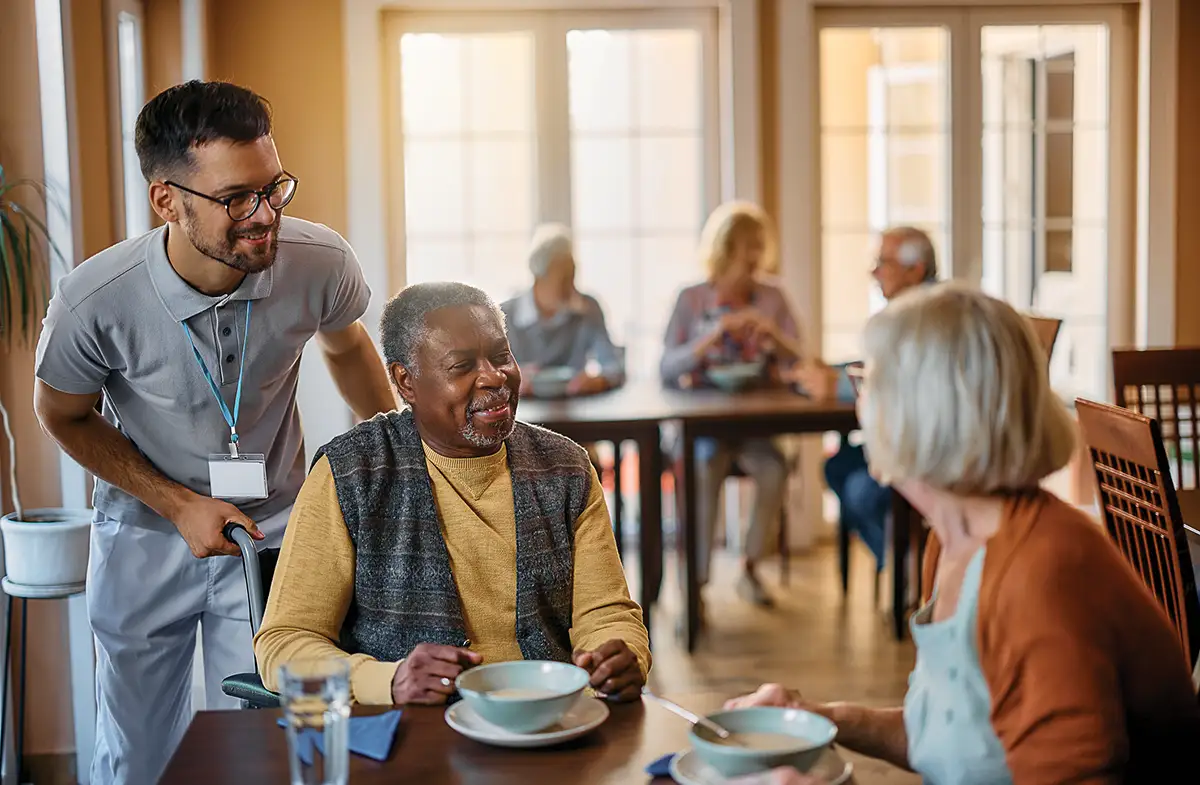
Dining is much more than simply nourishing the body; it is a sensory, emotional, and social experience. Dietitians are uniquely positioned to shape mealtime environments that support both nutritional and cognitive health. Three key strategies discussed below can help focus efforts.
Support Socialization
Social isolation is one of the most significant contributors to cognitive decline among older adults.11 Encouraging residents to dine together fosters belonging and connection.12,13 Communal meals support conversation, laughter, and engagement, all of which can improve mood and appetite.
Beyond mealtimes, RDs can champion programs that bring people together through food. Teaching kitchens, cooking demonstrations, and nutrition workshops combine education with social engagement. Group cooking classes, for instance, have been shown to improve not only dietary habits but also mood and social connectedness. Even when eating patterns do not change, participants often report improved mental health after these experiences.14 The act of cooking together offers a sense of purpose, creativity, and joy—powerful ingredients for cognitive resilience.
Encourage Autonomy
Promoting autonomy in the dining experience reinforces dignity and self-efficacy.15 Simple interventions can make a meaningful difference. Strategies like using adaptive equipment and dishware, maintaining menu options that reflect cultural preferences, and allowing flexible mealtimes and locations all empower residents to make their own choices.
Technology is also helping advance person-centered dining. Digital menus and ordering systems help track preferences and reduce frustration while giving residents greater control.16 These systems also generate data that help dietitians personalize menus and identify popular offerings.
Flexible dining scheduling may be one of the simplest yet most effective ways to foster independence. Allowing residents to eat when they feel most comfortable, rather than adhering to strict mealtime schedules, has been linked to improved intake and satisfaction.17,18
Stimulate the Senses
Food is a multisensory experience. Appearance, aroma, texture, and flavor all play a role in appetite and enjoyment. In long term care settings, where taste and smell may diminish with age or medication use, presentation becomes even more important.
We truly eat first with our eyes. Research shows that colorful, neatly plated meals are perceived as more appetizing and lead to increased intake compared with identical meals presented less attractively.19,20 Taking time to present food thoughtfully is not simply aesthetic; it is therapeutic. A visually appealing and aromatic environment can encourage residents to eat well and engage more fully with their meals, supporting both cognitive and physical well-being.
Designing Dining Environments for Cognitive Health
The physical environment shapes how residents experience food and social interaction. Well-designed dining areas can reduce stress, improve focus, and foster engagement. This is related to a concept known as environmental enrichment, which stimulates the brain through physical and social surroundings.21 Environmental enrichment has been associated with improved cognitive function and reduced dementia risk.22 For older adults, dining spaces can either support or hinder that potential.
Key environmental features that promote cognitive well-being include good lighting, noise control, color and contrast, accessibility, and familiarity.
Ample natural light and adjustable fixtures minimize glare and improve visibility. Studies supported by the Alzheimer’s Association show that increased light levels in dining rooms can boost caloric intake among residents with dementia.23
Reducing background noise and echo helps reduce confusion and anxiety. Warm, natural tones with clear contrast between tableware, food, and background surfaces enhance visibility and orientation. Ensure pathways and table arrangements accommodate mobility aids. Tables should be appropriately sized with comfortable heights, and seating is flexible with armrests to promote independence. Finally, a homelike aesthetic including real dishes, table service, and personal touches helps residents feel comfortable and oriented.24,25
Small changes can create a meaningful impact. Serving meals directly on tables rather than trays adds dignity and promotes engagement. Similarly, seating arrangements that encourage interaction can foster socialization; research from congregate meal settings shows that face-to-face configurations can directly influence conversation and engagement among older adults.26
As Archbishop Desmond Tutu says, “A person is a person through other persons; you can’t be human in isolation.” Our role as practitioners is not only to nourish residents physically but also to help create relationships and environments that make them feel truly human.
Barriers to Implementation and How to Address Them
While redesigning dining environments can greatly enhance cognitive well-being, implementation often encounters practical and cultural hurdles. A common challenge is staff resistance, especially when changes are perceived as added work or when benefits are unclear. Engaging staff early, identifying champions, and piloting small initiatives can build understanding and ownership.27
A common barrier may occur in staff lacking awareness of the “why” behind the change. When staff do not see how dining and environmental factors affect cognitive health, efforts risk being viewed as optional. Clearly communicating the purpose through data, stories, and resident feedback, and linking initiatives to quality and safety goals, helps align priorities.
Resource constraints such as funding, labor, and design expertise also limit progress. Yet many improvements can start small—such as enhancing lighting, updating tableware, or reducing noise—before larger investments are made.21 Phased implementation, alternative funding, and demonstrating returns through resident satisfaction can increase feasibility.
Additional challenges include competing priorities, project complexity, and long-term sustainability. Embedding initiatives into existing workflows and quality metrics, maintaining leadership support, and developing clear maintenance plans help ensure lasting impact.27
Transforming dining culture requires collaboration. Dietitians, health care teams, and designers must work together to align nutritional, emotional, and environmental goals.27 The process begins with an assessment of current dining practices to examine whether they promote autonomy, engagement, comfort, social connections during meals, and optimize lighting, sound, and accessibility for cognitive support.
From there, teams can set measurable goals, implement small changes, and gather resident feedback regularly. Aligning nutrition programming with cognitive health initiatives not only strengthens outcomes but also demonstrates measurable improvements in resident satisfaction and quality of life.27
In Conclusion
Prioritizing cognitive well-being is about more than preventing decline, it’s about enhancing the experience of living. By emphasizing patient experience, person-centered care, and thoughtful environmental design, RDs can help older adults eat better, think more clearly, and feel more connected. Prioritizing cognitive well-being is not just a health care initiative but also a commitment to enhancing the lives of those who have shaped our society.
— Gila Singer, MS, RDN, CSG, CDN, FAND, completed her dietetics training at Morgan State University and earned a master’s in applied nutrition from Lamar University. She is a certified specialist in gerontological nutrition and has experience across care settings. She currently serves as a manager in health care consumer experience. Recent achievements include multiple Journal of the Academy of Nutrition and Dietetics abstracts and presenting at the 2025 Dietetics in Health Care Communities Symposium. She enjoys teaching fitness classes and spending quality time with her husband and four children.
References
1. Lee LN, Kim MJ. A critical review of smart residential environments for older adults with a focus on pleasurable experience. Front Psychol. 2020;10:3080.
2. Wortmann M. Why a global action plan on dementia is so important. On Medicine; BMC Blog website. https://blogs.biomedcentral.com/on-medicine/2016/12/19/why-a-global-action-plan-on-dementia-is-so-important/. Published December 19, 2016. Accessed October 26, 2025.
3. Alzheimer’s disease facts and figures. Alzheimer’s Association website. https://www.alz.org/alzheimers-dementia/facts-figures. Accessed October 9, 2025.
4. Defining patient and human experience. The Beryl Institute website. https://theberylinstitute.org/defining-patient-experience/. Accessed October 9, 2025.
5. What is patient experience? Agency for Healthcare Research and Quality website. https://www.ahrq.gov/cahps/about-cahps/patient-experience/index.html. Updated March 2025. Accessed October 9, 2025.
6. Adams C, Walsan R, Schembri A, Sharma A, Walpola R, Harrison R. Does patient experience change with age? Exploring associations between patient experience, gender and age. Patient Exp J. 2024;11(1):141-148.
7. Elliott MN, Beckett MK, Cohea C, et al. The hospital care experiences of older patients compared to younger patients. J Am Geriatr Soc. 2022;70(12):3570-3577.
8. Andersson ÅG, Dahlkvist L, Kurland L. Patient-centered outcomes and outcome measurements for people aged 65 years and older—a scoping review. BMC Geriatr. 2024;24(1):528.
9. Doyle C, Lennox L, Bell D. A systematic review of evidence on the links between patient experience and clinical safety and effectiveness. BMJ Open. 2013;3(1):e001570.
10. Van Haitsma K, Abbott KM, Arbogast A, et al. A preference-based model of care: an integrative theoretical model of the role of preferences in person-centered care. Gerontologist. 2020;60(3):376-384.
11. Ng TKS, Beck T, Dennis KR, et al. Social isolation, loneliness, and their joint effects on cognitive decline and incident Alzheimer’s disease: findings from the Chicago health and aging project. J Prev Alzheimers Dis. 2025;12(3):100046.
12. Nijs KAND, de Graaf C, Kok FJ, van Staveren WA. Effect of family style mealtimes on quality of life, physical performance, and body weight of nursing home residents: cluster randomised controlled trial. BMJ. 2006;332(7551):1180-1184.
13. Altus DE, Engelman KK, Mathews RM. Using family-style meals to increase participation and communication in persons with dementia. J Gerontol Nurs. 2002;28(9):47-53.
14. Rees J, Fu SC, Lo J, et al. How a 7-week food literacy cooking program affects cooking confidence and mental health: findings of a quasi-experimental controlled intervention trial. Front Nutr. 2022;9:802940.
15. Carrier N, West GE, Ouellet D. Dining experience, foodservices and staffing are associated with quality of life in elderly nursing home residents. J Nutr Health Aging. 2009;13(6):565-570.
16. Svendsen JA, Beck AM, Sigersted Frederiksen AK, Knudsen AW, Munk T. Development of an electronic food ordering system and a la carte menu: enhancing patient involvement in nutritional care. Clin Nutr ESPEN. 2024;60:86-94.
17. Harstäde CW, Andersson S, Lagerbielke E, Sandgren A, Heikkilä K. Mealtime situations in nursing homes from the residents’ perspective – an integrative review. BMC Geriatr. 2025;25(1):103.
18. Davies M, Zúñiga F, Verbeek H, Staudacher S. Exploring resident experiences of person-centered care at mealtimes in long-term residential care: a rapid ethnography. BMC Geriatr. 2022;22(1):963.
19. Navarro DA, Boaz M, Krause I, et al. Improved meal presentation increases food intake and decreases readmission rate in hospitalized patients. Clin Nutr. 2016;35(5):1153-1158.
20. Zellner DA, Siemers E, Teran V, et al. Neatness counts. How plating affects liking for the taste of food. Appetite. 2011;57(3):642-648.
21. Engineer A, Sternberg EM, Najafi B. Designing interiors to mitigate physical and cognitive deficits related to aging and to promote longevity in older adults: a review. Gerontology. 2018;64(6):612-622.
22. Figuracion KCF, Lewis FM. Environmental enrichment: a concept analysis. Nurs Forum (Auckl). 2021;56(3):703-709.
23. McDaniel JH, Hunt A, Hackes B, Pope JF. Impact of dining room environment on nutritional intake of Alzheimer’s residents: a case study. Am J Alzheimers Dis Other Demen. 2001;16(5):297-302.
24. Parke B. Physical design dimension of an elder friendly hospital: an evidence-based practice review undertaken for the Vancouver Island Health Authority website. Semantic Scholar website. https://www.semanticscholar.org/paper/Physical-Design-Dimension-of-an-Elder-Friendly-An-Parke/de50ab906725625a2ad31ddcc222a0c386c0e522. Published 2007. Accessed October 9, 2025.
25. Chaudhury H, Hung L, Badger M. The role of physical environment in supporting person-centered dining in long-term care: a review of the literature. Am J Alzheimers Dis Other Demen. 2013;28(5):491-500.
26. Cheng MH, Zheng MC, Chen CY. Arrangements design of the congregate meal site to promote elderly interactive behavior. J Asian Archit Build Eng. 2023;22(4):2033-2046.
27. Luxford K, Safran DG, Delbanco T. Promoting patient-centered care: a qualitative study of facilitators and barriers in healthcare organizations with a reputation for improving the patient experience. Int J Qual Health Care. 2011;23(5):510-515.