



Today’s Dietitian
Vol. 28 No. 2 P. 8
During a fascinating webinar on the future of global food systems, I recently learned that, according to the United Nations Food & Agriculture Organization, 75% of the world’s food is generated from just 12 plants and five animal species. I smiled when I heard this, thinking about Iceland’s food culture. I had just returned from a two-week Icelandic vacation where the food culture both amused and impressed me.
Our trip started with a cruise from The Netherlands to Norway and Iceland. As our ship entered the first port in Iceland, I realized that I was arriving on a ship 155 years after my great-grandparents began leaving Iceland in search of a better life in North America.
I was eager to find a bakery that served kleinur and ástarpungar—Icelandic pastries similar to donuts. We walked to a bakery near the port that sold both pastries, but neither was exactly what I was expecting. This was my first experience in Iceland with the culinary adaptations that occur as people and recipes move around the globe.
Kleinur (twisted donuts) are made by rolling out a sweet dough to one-fourth of an inch thick and cutting it into a diamond (or rhombus) with a slit in the middle. One end is pulled through the center slit to create a shape that rolls itself in the hot oil as it cooks.
The kleinurat this bakery on the west coast and throughout the country were much bigger and fluffier than the smaller, crunchier versions I grew up eating. They were delicious, but they lacked the lemon zest and cardamom my mom used.
The ástarpungar (love balls) looked and tasted exactly as I expected, but their name was different. Everyone in the community where I grew up calls them astaballurs, which I suspect is an Icelandic-English mashup term. These donuts are dropped by spoonfuls into hot oil, and each ragged ball has a distinctive tail. These contained currants and lemon zest, and they were rolled in sugar and cardamom when they came out of the oil. Their aroma brought tears to my eyes as I recalled my parents making them for Christmas. After devouring one, I wanted to buy another, but my husband insisted we could buy more at the next bakery. He was wrong; we couldn’t find them anywhere else on the island, likely due to labor issues. Iceland’s popularity has caused a labor shortage in the hospitality industry. Young people from Poland flood the country each summer in search of work in hotels, resorts, and restaurants.
Historic Perspective
I’d had a trip to Iceland on my bucket list for many years after learning that all four of my great-grandparents on my father’s side emigrated from Iceland to the United States in the 1870s and 1880s. The mid- to late-1800s in Iceland were a time when intensely long, cold winters and natural disasters led to suffering, starvation, and mass emigration. A family history book tells of my great-grandparents, Jon Einarson and Sigridur Thorsteinsdottir, leaving their home near Vik, Iceland, in 1884 because “…the abundance of fish [off the southern coast of Iceland] had diminished and people were starving.”
The Icelandic Emigration Center in Hofsos, Iceland, shares stories of immigrants who left Iceland for Canada, the United States (especially North Dakota), and Brazil, desperate to find sustainable fishing conditions or productive farmland. All four of my great-grandparents on my dad’s side found very productive farmland in Gardar, a small settlement of Icelanders in what was then Dakota Territory and is now Pembina County, North Dakota.
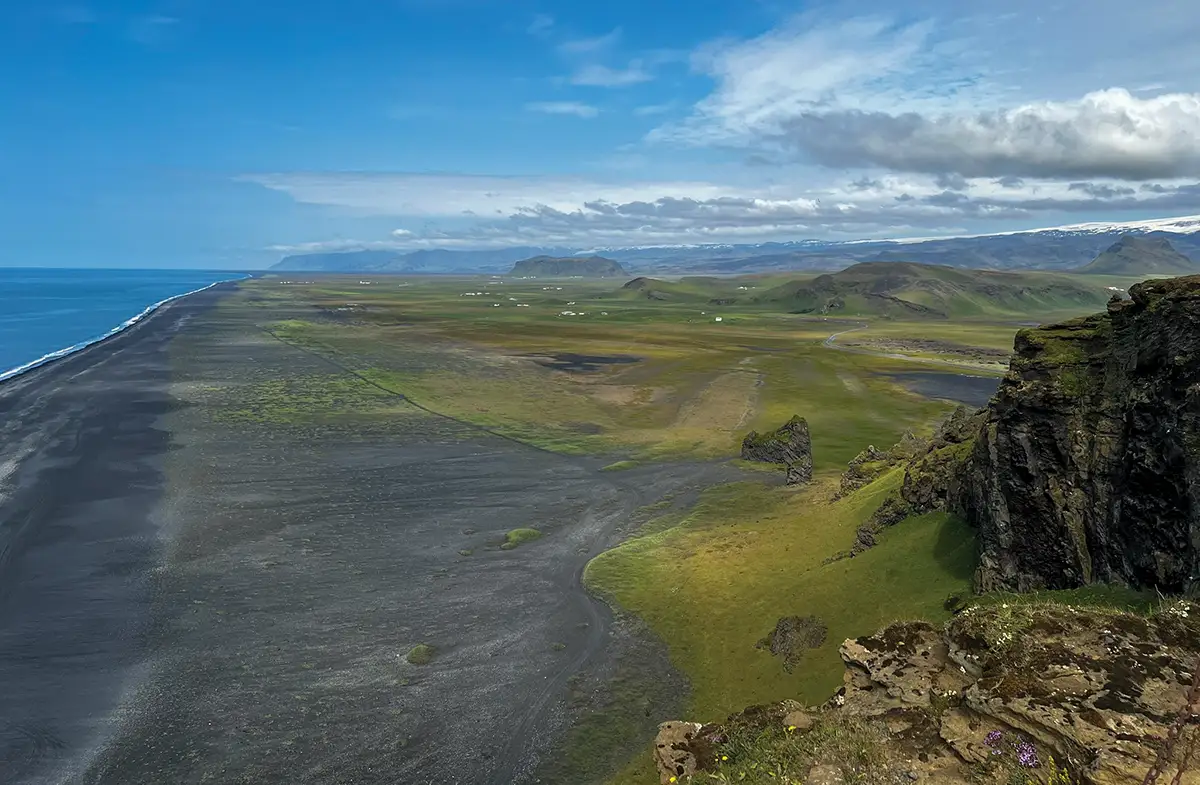
As we drove through Mýrdalsjökull (Myrdal glacier) and the village of Vík í Mýrdal, I was amazed at how similar the land looked to where I grew up. There were huge expanses of native grasses blowing in the wind and no trees. My great-grandparents must have been soothed by the familiarity. I was saddened to consider they likely didn’t realize just how cold the center of North America can be in winter months. The temperature in southern Iceland in January ranges from 12°F to 40°F; in North Dakota, the January temperatures are much more variable, ranging from -37°F to 50°F. The nearly 90-degree temperature variation must have been a shock to them after growing up in Iceland’s more temperate climate. But they must have also rejoiced in the rich soil and abundant production of their new home.
The farmland near Gardar, North Dakota, has eight or more inches of topsoil. Iceland has almost no topsoil, just rocky volcanic land best suited for grazing sheep. I was amused to learn that the only farmland that is fenced in Iceland are the alfalfa fields. Dairy farmers grow alfalfa to feed the dairy cows whose milk produces delicious skyr—Iceland’s version of protein-rich strained yogurt—and excellent cheeses. Millions of wild sheep graze across Iceland. Using electric fencing is the only way to keep them from eating the nutrient-rich alfalfa grown for dairy cows.
My great-grandparents and other Icelanders all raised sheep when they first settled near Gardar. They also started breaking up the land for farming, learning how to raise wheat, barley, and other crops. Wheat was the biggest crop my dad grew each year, and the same is true for my brothers and nephews who today farm on land that has been in our family for more than 100 years.
Bread Tales and Traditions
Homemade bread was part of my childhood food culture. My mom baked honey whole wheat bread nearly every week. She ground whole wheat flour from wheat grown by my dad and used clover honey from the honeybees that summered on our farm before heading back to work pollinating almond and citrus orchards in California every winter.
My father grew up eating Icelandic brown bread, which was likely adapted from Icelandic rye bread. Icelandic brown bread is a yeast bread made with graham flour or coarsely ground whole wheat flour, molasses, and butter. My mom often joked with my dad, saying Icelandic brown bread is more like cake than bread. Her honey whole wheat bread is delicious but not nearly as tempting as the Icelandic brown bread that my mom would make on rare occasion as a “treat” for my dad.
I loved walking into restaurants in Iceland for lunch and smelling the fragrance of freshly baked breads and pastries. In every hotel we stayed at during our Ring Road adventure we enjoyed breakfast buffets that featured Icelandic rye bread, sometimes referred to as geyser bread, a quick bread made with rye flour.
Dinner menus were more likely to feature wheat-based yeast breads served with compound butters beautifully displayed on lava rocks. Some compound butters featured seeds or herbs, and one featured caviar, but my favorite compound butter was the simplest, butter studded with toasted rye bread breadcrumbs. I suspect this was created by a hotel chef who wanted to use leftovers from the breakfast buffet in a profitable and delicious way. I now make it with the crusts of my California-Inspired Icelandic Rye Bread.
Geyser bread has a fascinating history. Wealthy priests in Iceland hoarded sugar, leaving peasants across the island with nothing to sweeten their food. Someone realized that if they buried containers filled with cracked rye and water, the heat would slowly break down the starch in the rye and create a slightly sweet, very dense unleavened bread. That early underground unleavened bread of medieval times eventually became today’s quick bread that can be baked in an oven in a few hours. A few hotels we visited in in Iceland still bake the bread by burying it underground near active geysers, a process that takes 24 hours.
Why did my ancestors in North Dakota grow wheat instead of rye? Rye was great for Iceland, but wheat was a better choice in North Dakota. Rye is a relative of wheat that adapted to growing in harsh conditions. It has a root structure that can dip deeper for water and nutrients. Wheat has a shallower root structure, although, if necessary, it can develop longer roots to access moisture and minerals. Wheat grows very well in the rich topsoil of northeast North Dakota.
What’s on the Menu?
A commonality among menus in Iceland is the lack of choices. Dinner menus often include one soup, one or two salads, three to four entrees of which one is always vegan, and one or two desserts. While vegan options are common, I don’t recall seeing a single gluten-free menu offering.
The only menus that had abundant choices were the beer menus at craft breweries in even the smallest villages. The beer culture in Iceland is interesting and exciting. Beer brewing, sales, and consumption were not allowed in Iceland from 1915 to 1989. After the 74-year prohibition, breweries gradually sprung up in cities and villages across the country. Today, Icelanders celebrate Beer Day on March 1, the day the prohibition was lifted in 1989.
Worth Every Króna
As I was planning our trip to Iceland, friends and family who had visited the country all said, “Iceland is so expensive,” but no one said, “But it’s worth every penny.” I now believe eating in Iceland is worth every króna. Speaking of Icelandic currency, we spent the last of ours at the duty-free shop in the Keflavik Airport, buying obscene amounts of premium Icelandic dark chocolate bars.
I have always been fond of the Icelandic foods of my childhood, but after spending two weeks eating in Iceland I have so much respect for its current food culture. If you get a chance to visit, do so. Iceland is a beautiful country with an intriguing food culture.
— Amy Myrdal Miller, MS, RDN, FAND, is an award-winning dietitian and cookbook author, and president of Farmer’s Daughter Consulting. Her clients include global seed companies, produce companies, and dairy producers. A farmer’s daughter from North Dakota, today she lives outside Sacramento, California, with her husband and two cats, where she enjoys golfing, gardening, and listening to smooth jazz.