|
E-Newsletter • January 2026 |
▼ ADVERTISEMENT

|
Editor's E-Note
Off With a Bang!
We’re only a few weeks into 2026 and nutrition is already making big headlines with the release of the latest Dietary Guidelines for Americans. At Today’s Dietitian (TD), we are eager to weigh in on these important developments with an in-depth expert exploration due for release in a future issue—so stand by! Meanwhile, in this month’s E-News Exclusive, we reflect on the two-year anniversary of another big change in the dietetics profession: the graduate degree requirement. How has this new requirement impacted RDs in practice and those considering entering the profession? We identify the potential benefits, emerging challenges, and ways some RDs are using this as a bridge to expand their scope of practice into related fields.
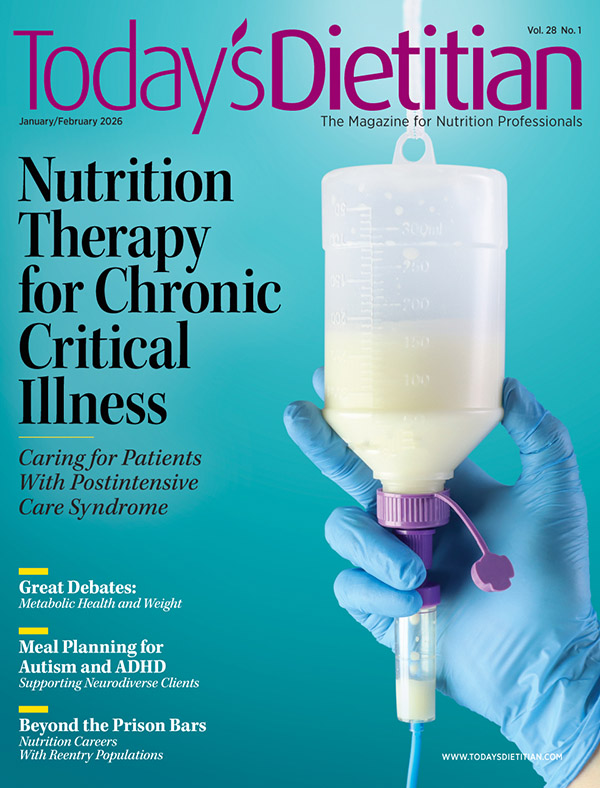
After reading the article, visit TD’s website at www.TodaysDietitian.com to read the digital edition of our January/February issue, featuring our clinically focused cover story, “Nutrition Therapy for Chronic Critical Illness.” You’ll also find features on meal planning for autism and ADHD, the lesser-known area of dietetic practice with prison reentry populations, and an exciting edition of our Great Debates series tackling the topic of metabolic health and weight.
Please enjoy the E-Newsletter and give us your feedback at TDeditor@gvpub.com, and don’t forget to like us on Facebook and follow us on X, formerly known as Twitter.
Happy New Year!
— Heather Davis, MS, RDN, LDN, editor |
|
|
| In This E-Newsletter
|
|
▼ ADVERTISEMENT
 |
|
|
Reflecting on the RD Graduate Degree Requirement
By Sophia Condic, MS, RDN
Beginning in January of 2024, the Commission on Dietetic Registration (CDR) bumped up the minimum required education level for prospective RDs from a bachelor’s degree to a master’s degree.1 It’s the two-year anniversary of the change and we’re taking stock of the impact. How has the new requirement affected dietetic programs and practice throughout the United States?
Undergraduate programs need to ensure that coursework and hands-on experiences will prepare students for graduate school. Additionally, with the support of professors, preceptors, and mentors, undergraduate students looking to become dietitians will be able to choose a graduate degree and school that will prepare them for becoming an RD.
The Impact on Up-and-Coming RDs
Undergraduate students on the path to becoming RDs will enroll in a didactic program in dietetics (DPD) that has been accredited by the CDR.2 The Academy of Nutrition and Dietetics (the Academy) states that a DPD is “an academic program designed to meet the knowledge requirements for dietetics practice.”2 Although each DPD program has their own coursework requirements needed to graduate, there are some standardized prerequisites that should be the same across all DPD programs.
The Occupational Outlook Handbook through the US Bureau of Labor Statistics reports that those with a bachelor's degree in a nutrition-related field will have classes that focus on anatomy, biology, and physiology.3 Yet, Elizabeth MacQuillan, PhD, RDN, CHSE, and program director for the DPD program at Grand Valley State University, says, “Other courses or some type of experiential learning and research methods content or undergraduate research opportunities are key to the DPD student success.”
|
Metabolic Roots of Memory Loss
For decades, scientists have known that what harms the body often harms the brain. Conditions such as obesity, high blood pressure, and insulin resistance strain the body’s vascular and metabolic systems. Over time, that stress can speed up cognitive decline and increase the risk of Alzheimer’s disease.
Now, researchers at Arizona State University and their collaborators report that these effects may begin far earlier than expected. In young adults with obesity, the team identified biological markers of inflammation, liver stress, and detection of markers indicative of early damage to brain cells—subtle changes that reflect patterns also seen in older adults with cognitive impairment.
The study also highlights a surprising companion finding: these young adults had unusually low blood levels of choline, a key nutrient and organic compound crucial for liver function, inflammation control, and long-term brain health.
▼ ADVERTISEMENT
Improved Food Insecurity Screening for Navajo Nation Patients
A new study published in the Journal of Nutrition Education and Behavior highlights the development of a culturally informed approach to screening for food insecurity among patients at Northern Navajo Medical Center (NNMC) in Shiprock, New Mexico. The alternative screener aims to reduce stigma, improve patient comfort, and reflect local food traditions and community food access better.
American Indian households experience food insecurity at disproportionately high rates—nearly four times that of the general US population. In the Navajo Nation, geographic isolation, limited grocery store access, high food costs, and transportation barriers contribute to this ongoing public health challenge. Standard screening tools, however, were developed without significant input from American Indian communities and may not capture culturally relevant dimensions of food security.
|
CPE Monthly
In the January/February issue of Today’s Dietitian, learn about the research related to time-restricted eating in oncology care. Read the CPE Monthly article, take the 10-question online test at CE.TodaysDietitian.com/CPEmonthly, and earn two CPEUs!
Upcoming Webinars and Coupons
Get ready for 2026 with a variety of CE webinars! Check out the latest live presentations, including sessions that focus on diabetes, nutrition personas, nutrition and bipolar disorder, and parts 2, 3, and 4 of our Microdoses of Mindfulness series. Check out our full list of upcoming live and recorded offerings here.
For a limited time, save 25% on the Menopause Bundle (4.5 CEUs!) when you register for Midlife Unlocked: Understanding Women's Hormones and Health. Put the webinar and the bundle in your shopping cart and use coupon code 25MIDLIFE25 to redeem your discount!
In 2026, focus on treating patients with diabetes more effectively! Get 25% off your order when you use coupon code DIABETES2026 on the purchase of the Compassion in Action: Inclusive Care for Patients with Diabetes, Dietitians in Primary Care: Collaborative Solutions to Complex Diabetes-Cardiometabolic Health, and Embracing Metabolic Surgery for Type 2 Diabetes webinars! (Be sure to put all three webinars in your cart for the discount to be applied.)
2026 Spring Symposium
Advance your practice, expand your perspective, and connect with leaders shaping the future of nutrition care at the 2026 Today’s Dietitian Spring Symposium. This dynamic, multi-day event delivers practical, evidence-based education you can apply immediately—along with meaningful networking and idea-sharing with colleagues from across the country. Whether you’re looking to sharpen clinical skills, explore emerging trends, or reignite your professional momentum, Spring Symposium offers an engaging learning experience designed to support real-world impact.
Register now to secure your spot and be part of the conversation.
Recorded Spring Symposia Packages
Did you miss the 2025 Spring Symposium? Don’t worry! We have you covered with our Recorded Spring Symposia Packages. Pick and choose the sessions you want and create your own Symposium adventure. Choose from 5, 10, or 15 sessions. |
Twofold
Considered one of the top AI notetakers for dietitians according to pooled opinions from real RDs in practice and dietetic students, Twofold is a tool enabling fast, accurate, and medically compliant (including HIPAA protected) notetaking. Learn more » |
In the March/April Issue
• The Fight for Fair Wages
• Culinary Sports Nutrition
• A New Consensus on Nutrition Therapy for IBD
• TD10 |
|
|
COVER STORY
Nutrition Therapy for Chronic Critical Illness
Postintensive care syndrome may occur in some patients who survive the initial illness which precipitated their ICU stay but continue to require intensive medical care and rehabilitation. Learn about symptoms and management considerations for this vulnerable group.
FEATURE
Great Debates: Metabolic Health and Weight
The concepts of “metabolically healthy obesity” and “metabolically unhealthy normal weight” continue to show up in discussions about weight and health. Explore the controversy, including how they fit into the larger conversation about weight inclusivity, evidence-based care, and reducing long-term risk for cardiometabolic diseases such as diabetes and CVD.
|
|
|
| Advertising Opportunities |
Have a product or service you want to market to nutrition professionals? Utilize the reach of Today’s Dietitian Magazine to accomplish your marketing goals. E-mail our experienced account executives today at sales@gvpub.com or call 800-278-4400 for more information.
|
| © 2026 Today’s Dietitian Magazine |
|
|